
The video above will be available to stream live at 11:00 AM HAST on July 17, 2024. You may watch the recording here at any time afterward. You will need to click the Play button to view the live video.
Posts
Unpreached Sermon: Gotta Dance
This sermon was prepared for worship on July 14, 2024, but not preached because of the assassination attempt against a Presidential candidates on July 13. Instead, Pastor Eric preached “Repeating Myself.”
July 14, 2024
2 Samuel 6:1-5, 12-19
Psalm 24
In the 1952 musical film, Singing in the Rain, there’s a musical number that has never made any sense to me. I grant you that people suddenly bursting into song is standard fare for musicals, which doesn’t make sense to a lot of people, but I never had any problem with that. No, the movie introduces a musical number that’s being included in the fictional 18th century movie The Dancing Cavalier, and the musical number, “Broadway Melody,” is all about somebody who comes to Broadway to become a dancer.
And no, I never have been able to figure out how that went together, but hey, it’s a musical. It’s also amazing. Gene Kelly did some of his best dance work in the number, and it also featured Cyd Charisse. Most of all, it began and ended with Kelly’s musical shout, “Gotta dance!”
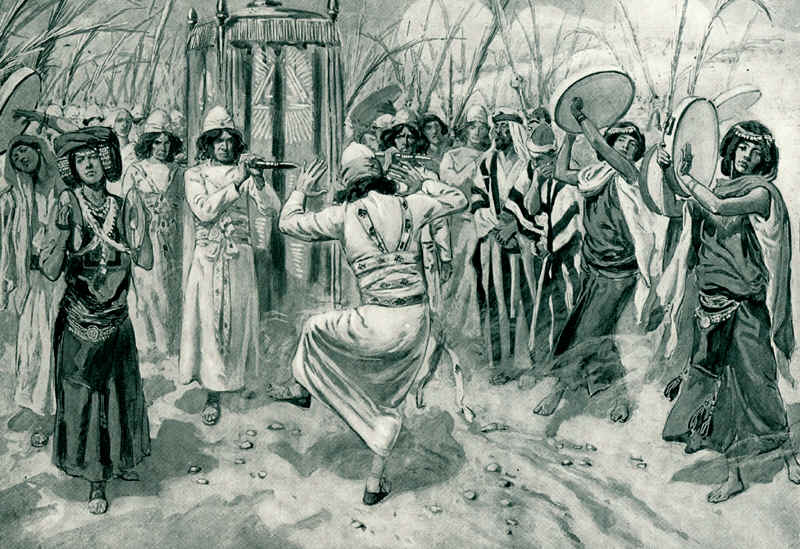
King David couldn’t have heard that musical phrase, but he certainly understood it. When they decided to bring the Ark of the Covenant to Jerusalem, he led the procession in a dance. “Gotta dance,” was the phrase of the day, because it wasn’t just David. It was other people in the procession. “David and all the house of Israel were dancing before the LORD with all their might, with songs and lyres and harps and tambourines and castanets and cymbals.”
The ark had been in one place for twenty years. Those were eventful years. Israel had selected a monarch for the first time, King Saul. That hadn’t gone so well. God had appointed a new monarch, David, and while the two worked together for a while David lived as leader of a small armed rebellion for many years. Saul and many of his sons died in battle with the Philistines, but one, Ishbaal, survived and was acclaimed king by the most of the twelve tribes. David ruled in the south until Ishbaal was assassinated, leaving David as undisputed monarch of Israel.
The next thing he did was to seize the Jebusite city of Jerusalem, which had been an independent city-state within the lands the Hebrew people inhabited. David made it the new national capital, and not-very-modestly named it “The City of David.” The new city would not be associated with either the house of Saul or with the places David had ruled while contesting for the throne. It was about as close as they could come to creating a new beginning.
About the only thing missing: the Ark of the Covenant. The chest which contained the stone tablets of the Ten Commandments. The symbol of God’s blessing. The central object that represented God’s commitment to the nation. It had been just ten miles away from Jerusalem for twenty years. The time had come to bring it to the political and social center of the nation, and make it the religious center, too.
As Richard W. Nysse writes at Working Preacher, “David’s exuberance can be read as pure gratitude for what Lord has granted him, but it can also be interpreted as politically astute manipulation.
“In other words, David’s motives are not pure and yet God is involved. Sin is real and faith is real; at times they are concurrent in one event and one character. The narrative leaves room for both readings. Perhaps it even insists on both readings, and thus depicts a world that has resonance with our own.”
Gotta dance. But who is he dancing for?
It’s easy to make David into a self-interested political manipulator. He did such things. The worst of them was the rape of Bathsheba and the murder of Uriah, but they’re not the only such acts. During his days as a rebel he was also a mercenary for neighboring (and hostile) nations as well as something of a bandit. As John C. Holbert writes in his blog at Patheos, “There can be little doubt that David loves YHWH in these wonderful stories. But there can also be little doubt that, at times at least, he loves himself more.”
Is that the case here? David paused the festival parade between verses 5 and 11 because of a tragic accident that killed one of the attendants. “David was angry because the LORD had burst forth with an outburst upon Uzzah…” says the text – not afraid, not cautious, not concerned: angry with God. That tends to reinforce some of my suspicious cynicism.
There are other reasons to work the politics of something, though, and that’s the welfare of the nation. David ruled a nation that had suffered years of low-level civil war while they were also vulnerable to repeated conflicts with their neighboring nations. Hostilities between David and surviving members of Saul’s extended family were still conceivable. It didn’t just serve David, it served the nation to create a new sense of unity, to demonstrate that the new monarch would rule justly and with care for everybody’s welfare. Jerusalem’s clean slate, if the Ark of the Covenant could be brought there, would be endorsed by the God of the Exodus who had brought everyone to a new home.
Look, everyone, it’s a new home.
Gotta dance for that.
Well. Maybe.
David’s first wife (the authors of Second Samuel had lost count of his wives in chapter five), Michal, “looked out of the window and saw King David leaping and dancing before the Lord, and she despised him in her heart.” If David had been channeling “Gotta Dance” she was in tune with the Jerome Kern song, “I Won’t Dance,” sung by Frank Sinatra in 1957 (and a whole lot of other people after that). Michal, it turns out, thought that David went over the top with his dancing, even making some pointedly rude comments about it. It basically ended any positive feeling in their relationship.
“Gotta dance?” Or “I won’t dance?” Which would you prefer?
Barbara Messner writes in her blog:
I have witnessed sacred dancing
that has stirred my very being:
wordless meaning that’s enhancing
prayer inspired by what I’m seeing –
spirit stirring, feelings freeing.Yet our mainstream church disdains it,
though the censure is unspoken:
formal liturgy restrains it
into gestures that are token,
careful that no power is woken.
The technicolor rainbow of Christianity has a lot of variety in it: in theology, in organization, in spiritual style, and in the energy of worship. There are parades in churches of the Roman Catholic, Orthodox, and Anglican traditions, but they don’t look much like David’s leaping and dancing. They’re grand; they’re stately. They’re measured; they’re dignified. And on any given Sunday morning, there’s church choirs swaying and even performing dance steps in Baptist churches. There are people crying out spontaneously from the congregation in Pentecostal churches.
On Palm Sunday here, we circle round the sanctuary singing and waving palms, and we might be dancing if I were better at it.
David and those with him, they chose, “Gotta dance.” Yes, there was calculation to it, but people do things for lots of reasons. As Amy G. Oden writes at Working Preacher, “David and ‘all the house of Israel’—all 30,000 of them!—dance before the Lord “with all their might” (verse 5)! Even the list of instruments: ‘lyres and harps and tambourines and castanets and cymbals’ (verse 5) conveys exuberance. Holy Presence may invite us into quiet contemplation, into bold action or renewed commitments. Here it evokes festive joy.”
We have some dancing enthusiasts among us. Not 30,000 of them. We have some singing enthusiasts among us. Not 30,000 of them, either. We aren’t terribly exuberant people here at Church of the Holy Cross. But… I know myself well enough to know that there’s some more celebration in me than I usually display. There’s some joyful energy even within this example of a New England Congregationalist, often known as “God’s Frozen Chosen.” I’m more likely to sing it than to dance it, but you know, it’s gotta come out.
Gotta sing. Gotta dance.
We’ve gotta sing and gotta dance because God’s blessings are manifest all around us. Look at those trees. Look at those flowers. Look at that sky (even if it’s gray). Look at that ocean. Look at those people whose smile is brighter than a sunrise. Isn’t that enough reason to rejoice?
But more: we have a congregation worth celebrating, one that care for our neighbors and welcomes the newcomer. We have a commitment to one another and to those who have gone before us. We live and serve with other congregations of the United Church of Christ and the universal Church who share our commitments, our ministry, and our joy. That’s worth celebrating, isn’t it?
And most of all: we have a God of love and grace, a God of forgiveness and redemption, a God of presence and inspiration. What we see and hear and smell and feel and taste is just a fraction of the wonder that is our God. God is with us.
God is with us. So yes: Gotta dance!
Amen.
by Eric Anderson
The image is David Danced before the LORD with All his Might (circa 1896–1902) by James Tissot – http://www.gci.org/files/images/jt/TissDanc.jpg, Public Domain, https://commons.wikimedia.org/w/index.php?curid=15343206.
Sermon: Repeating Myself
July 14, 2024
Exodus 20:13
Luke 22:47-51
From time to time on social media, I introduce a thought with something like these words: “I shouldn’t have to say this,” or “I shouldn’t have to say this again,” followed by, “but I guess it has to be said: You don’t get to kill people.”
Yesterday’s event in Pennsylvania, when someone with a rifle apparently attempted to assassinate Donald Trump, killed a spectator and wounded three people including the former president, leads me to say it again. You don’t get to kill people.
Honestly, that ought to be all I have to say about it, but sometimes a preacher has to toss out the prepared sermon about rejoicing in God’s grace and glory and take a look at the things we don’t rejoice in so much. Human violence.
I wrote this in 2016: “I guess it needs to be said: You don’t get to kill someone because they’re different. God made LGBTQ folks. Muslim folks. Black folks. Brown folks. You don’t get to kill them because of any of that.
“You don’t get to kill people because you’re angry, or scared, or offended, or embarrassed. You don’t get to kill them out of resentment or a sense of betrayal. You don’t get to kill them out of privilege or pride. You don’t get to kill them.
“When the sword flashed in the Garden of Gethsemane, Jesus said, ‘Enough of this.’
“Two thousand years and millions of dead later, haven’t we had enough?”
It took just three words in Hebrew for God to command us not to murder. Jesus used three words again to still his follower’s violence. I’m a lot wordier.
And it still isn’t enough.
Can we admit that we glorify violence? Can we admit that there is something compelling about the spectacle of it all? We don’t entertain ourselves with actual deaths, the way the Romans did, but we do entertain ourselves with imitated violence (the Romans did that, too). The ancient Hawaiians praised the prowess of their warriors, as did the Japanese, Europeans, and native Americans. That’s accomplishment in violence.
Amidst the acclaim of the warrior, where is the voice of Jesus saying, “Enough of this”?
The United States is awash in guns. We’re also second to Brazil in the number of deaths each year. I’ve said this before, too. The problem with guns is not the increase in violence, it’s the increase in deadly violence. Guns make it easier to kill.
With a lot of guns around, it’s shockingly easy to kill.
Can’t we make it harder?
I don’t know. Americans do like their guns.
To be honest, as long as continue to praise the warrior rather than the peacemaker, then the worship of guns rather than the worship of God will have dominion.
Enough of this.
I don’t really have a practical solution. I have a spiritual solution. It’s a spiritual solution that’s been available to humanity for the two thousand years since Jesus. It’s a spiritual solution that’s been available to humanity for the twelve hundred years or so before Jesus when God gave Moses the Ten Commandments. “Do not murder.” It’s got the virtue of simplicity.
For the most part, it’s worked.
It’s just not working well enough.
Please God, let it work better.
Amen.
by Eric Anderson
Watch the Recorded Sermon
Pastor Eric wrote this new sermon in response to the events of July 13, 2024, on the morning of July 14.
The image is La guérison de Malchus (The Healing of Malchus) by James Tissot (between 1886 and 1894) – Online Collection of Brooklyn Museum; Photo: Brooklyn Museum, 2008, 00.159.239_PS2.jpg, Public Domain, https://commons.wikimedia.org/w/index.php?curid=10904580.
Worship for July 14, 2024
Thank you for joining us for this live stream (or recording, as the case may be) of Sunday worship. May it bless you! You may need to click “Play” to launch the stream, which will be live around 9:50 AM.
Welcome to the live stream of worship from Church of the Holy Cross for Sunday, July 14, 2024. You will find the service outline below, and you may download and print the PDF to follow more easily.
Service of Worship July 14, 2024
Eighth Sunday after Pentecost
Rev. Eric S. Anderson, Pastor
WE GATHER TO WORSHIP GOD
Prelude: Prelude in E Flat Kayleen Yuda
Lighting of the Candles
Ringing of the Bell
Welcome Rev. Eric S. Anderson
* Call to Worship: (based on Palm 85:8-13) Cindy Debus
Leader: Let us hear what God the LORD will speak.
People: May the LORD speak peace to the peoples of the Earth!
Leader: Surely God’s salvation is at hand for those who revere the LORD.
People: Steadfast love and faithfulness will meet; righteousness and peace will
embrace.
Leader: Let faithfulness spring up from the ground, and righteousness look down from
the sky.
People: The LORD will give what is good, and our land will hold and feed us.
All: Let us worship God!
* Hymn #4: Joyful, Joyful, We Adore You (v. 1-4)
* Invocation (based on Ephesians 1:3-14) Cindy Debus
We bless you, O God, and we praise you for Jesus Christ. You have made us your children, you have freely bestowed your grace. In Christ you have given us an inheritance so that we might live in your glory. Hear our prayers today, O God, as we rejoice in your salvation. Amen.
Please be seated
WE SHARE THE WORD OF GOD
Anthem: A Canon of Praise Holy Cross Singers
Time with the Children
Scripture: 2 Samuel 6:1-5, 12-19 Cindy Debus
David again gathered all the chosen men of Israel, thirty thousand. David and all the people with him set out and went from Baale-judah, to bring up from there the ark of God, which is called by the name of the Lord of hosts who is enthroned on the cherubim. They carried the ark of God on a new cart, and brought it out of the house of Abinadab, which was on the hill. Uzzah and Ahio, the sons of Abinadab, were driving the new cart with the ark of God; and Ahio went in front of the ark. David and all the house of Israel were dancing before the Lord with all their might, with songs and lyres and harps and tambourines and castanets and cymbals.
It was told King David, ‘The Lord has blessed the household of Obed-edom and all that belongs to him, because of the ark of God.’ So David went and brought up the ark of God from the house of Obed-edom to the city of David with rejoicing; and when those who bore the ark of the Lord had gone six paces, he sacrificed an ox and a fatling. David danced before the Lord with all his might; David was girded with a linen ephod. So David and all the house of Israel brought up the ark of the Lord with shouting, and with the sound of the trumpet.
As the ark of the Lord came into the city of David, Michal daughter of Saul looked out of the window, and saw King David leaping and dancing before the Lord; and she despised him in her heart.
They brought in the ark of the Lord, and set it in its place, inside the tent that David had pitched for it; and David offered burnt-offerings and offerings of well-being before the Lord. When David had finished offering the burnt-offerings and the offerings of well-being, he blessed the people in the name of the Lord of hosts, and distributed food among all the people, the whole multitude of Israel, both men and women, to each a cake of bread, a portion of meat, and a cake of raisins. Then all the people went back to their homes.
Psalm 24
The earth is the Lord’s and all that is in it,
the world, and those who live in it;
for he has founded it on the seas,
and established it on the rivers.
Who shall ascend the hill of the Lord?
And who shall stand in his holy place?
Those who have clean hands and pure hearts,
who do not lift up their souls to what is false,
and do not swear deceitfully.
They will receive blessing from the Lord,
and vindication from the God of their salvation.
Such is the company of those who seek him,
who seek the face of the God of Jacob.[a]Selah
Lift up your heads, O gates!
and be lifted up, O ancient doors!
that the King of glory may come in.
Who is the King of glory?
The Lord, strong and mighty,
the Lord, mighty in battle.
Lift up your heads, O gates!
and be lifted up, O ancient doors!
that the King of glory may come in.
Who is this King of glory?
The Lord of hosts,
he is the King of glory.
Sermon: Gotta Dance Rev. Eric S. Anderson
WE RESPOND IN WORD AND DEED
Pastoral Prayer Rev. Eric S. Anderson
Please join me in the Lord’s Prayer
Our Father, who art in heaven, hallowed be Thy Name. Thy kingdom come. Thy will be done on earth as it is in heaven. Give us this day our daily bread. And forgive us our debts, as we forgive our debtors. And lead us not into temptation, but deliver us from evil. For Thine is the kingdom, and the power, and the glory forever and ever. Amen
* Hymn #524: This Little Light/This Joy I Have (v. 1-4)
Call to Offering Cindy Debus
David did not just dance before the LORD. He brought musicians, he equipped a cart, he prepared a tent, he fed a multitude with a feast. We do not have David’s resources, but together we can joyfully proclaim the gifts of God with our offerings. Whether you share your gift here in the church today, through a gift online, or via an envelope in the mail, let the offering now be received.
Offertory: Elevation Kayleen Yuda
* Doxology
Praise God from whom all blessings flow,
Praise Him all creatures here below
Praise Him above ye heavenly host
Praise Father, Son and Holy Ghost – Amen
* Offertory Prayer Cindy Debus
We rejoice in your grace, O God, as each day dawns and as each evening falls. Bless these gifts as expressions of our joy in you, and guide them so that others may also know the wonders of your love. Amen.
* Hymn #471: What a Covenant (v. 1-3)
Please be seated
Announcements Rev. Eric S. Anderson
Benediction Rev. Eric S. Anderson
Postlude: Praises Kayleen Yuda
* Please stand if you are able.
Permissions
Prelude in E Flat
Alexandre Guilmant
Streamed by permission ONELICENSE A-735890
Joyful, Joyful, We Adore You
Text by Henry van Dyke, 1907
Tune HYMN TO JOY by Ludwig van Beethoven, 1824
Adapt. by Edward Hodges, 1846
Public Domain
A Canon of Praise
Natalie Sleeth
Text: © 1969 Choristers Guild
Streamed by permission ONELICENSE A-735890
This Little Light/This Joy I Have
Text trad. African-American spiritual
Tune THIS JOY trad. African-American spiritual
Arr. Jeffrey Radford, 1993
© 1993 The Pilgrim Press
Streamed by permission ONELICENSE A-735890
Elevation
Alexdre Guilmant
Streamed by permission ONELICENSE A-735890
What a Covenant
Text by Elisha A. Hoffman, c. 1887
Tune LEANING by Anthony J. Showalter, 1887
Public Domain
Praises
Dennis Eliot
Tune: © 1978 Lorenz Publishing Company
a division of The Lorenz Corporation
(Admin. by Music Services)
Streamed by permission ONELICENSE A-735890
Important Friendly Notice
Do you have a keiki entering the Third Grade and would you like the Church to present your keiki with a Bible? Please let the Church Office know by July 24, 2024. We would like to present the Bibles during service on August 11. Be sure to let us know what name you would like in the Bible–keiki’s full, formal name or a shortened name.
Dates to Remember
Today: July 14–Council Meeting after worship
Today: July 14–Dedication of Bread for the World
Pastor Rev. Eric S. Anderson
Moderator Stefan Tanouye
Lay Reader Cindy Debus
Choir Accompanist Kanako Okita
Choir Director Doug Albertson
Organist Kayleen Yuda
Hand Bell Director Anna Kennedy
Chapel Decorations Ben Masutomi
Projected Imagery Sue Smith
Web Master Ruth Niino-DuPonte
Videographers Eric Tanouye, Ben Yamaki, Eli Yamaki
Ruth Niino-DuPonte, Bob Smith
We welcome you to worship this day. Church of the Holy Cross seeks to help its members, friends, and visitors follow the guidance of God, Christ, and the Holy Spirit, encouraging all people to love one another according to the teachings of Jesus. We live and teach the faith, speak good news, minister to people near and far, and work with other households of faith and helping agencies to improve our community and our world. To support our ministries, please visit our Donate Page.
Pastor’s Corner: Cruelty or Compassion?
July 10, 2024
Three hundred years ago on the islands of Hawai’i, making a living was not easy. Fishing ran the risks of sudden storm or rogue waves. Kalo farming required backbreaking labor in the most congenial of soils, and even more when the soil was thin or the water scarce. Fruit may simply grow on trees, but retrieving it wasn’t easy.
Homelessness, however, couldn’t be said to exist. When people left their homes they had a lot of options for building a new hale for themselves. The materials stood in the forests, and very rarely would anyone turn up to say, “You can’t live here.”
Homelessness is a product of a civilization in which some people have access to land, and some do not.
Recently the United States Supreme Court upheld an ordinance of Grants Pass, Oregon, banning “camping” on public land by involuntarily homeless people regardless of the availability of shelter beds. Those who have no other place to go – which is basically the definition of homelessness – can be arrested and jailed. I suppose those people could leave Grants Pass, Oregon, but what if the neighboring communities have similar bans? How soon do the options become a single option: Go directly to jail?
These measures explicitly criminalize poverty.
In the opinion of these stone-hearted justices, the United States Constitution permits such an injustice. Mercifully, it does not require it. We must be better than the Constitution here in Hawai’i, and on Hawai’i Island. We must address the problems of overpriced housing, inadequate mental health resources, and overcrowded substance abuse programs.
The Supreme Court has shown us the way of cruelty. Let us take the way of compassion.
In peace,
Pastor Eric
What I’m Thinking: David Danced
David danced enthusiastically as they moved the Ark of the Covenant to Jerusalem. Do we fully appreciate the joy of faith?
Here’s a transcript:
I’m thinking about the sixth chapter of Second Samuel (2 Samuel 6:1-5, 12-19), when King David brought the Ark of the Covenant into the city of Jerusalem.
The description is of quite a major festival. there are priests, there are attendants, there are musicians, there are lots and lots of people joining in a great parade, and there, somewhere either in the front or in the midst of it (in any case not far in front of the Ark itself upon its cart), King David danced, danced energetically, enthusiastically. Later on he would be criticized by one of his wives for it.
David danced before the Lord.
There are branches of Christianity, and the Congregational tradition is clearly one of them, in which enthusiasm, emotion in worship, well, we’re not enthusiastic about it. We meet a text like this with a certain amount of, well, discomfort. How could someone dance before the Lord so energetically that later on his wife would criticize him for being too exultant?
And indeed, if you look at worship from Church of the Holy Cross you will find that I as a worship leader am fairly measured, and that we as a worshipping congregation are not terribly given towards emotional excess. But maybe we can find a little more room for it.
Why do we want to set aside the joy of faith?
Oh, I am certainly somebody who could be a reason why faith doesn’t seem so joyful. I will happily tell you about all the things that God wants you to do, God wants me to do, and how difficult they all are. That’s very much the case.
But isn’t it true that the very first thing that God wants us to do is rejoice in life? Isn’t it true that the very first thing that God wants us to do is to appreciate the wonders around us? Isn’t the very first thing that God wants us to do is to rejoice in the inexhaustible, ever-flowing love of our Creator, our Redeemer, and our Sustainer.
I confess you’re not likely to find me dancing down the aisle (although I try to wave a palm branch pretty enthusiastically on Palm Sunday). Still, we might find some ways to open our hearts a little wider, mightn’t we? We might find some ways to let our spirits and even our bodies move just a little bit, or a little bit more. We might find ways to celebrate the love of God and to let our joy ring out.
That’s what I’m thinking. I’m curious to hear what you’re thinking. Leave me your thoughts in the comment section below. I’d love to hear from you.
A Song from Church of the Holy Cross: July 10, 2024
The video above will be available to stream live at 11:00 AM HAST on July 10, 2024. You may watch the recording here at any time afterward. You will need to click the Play button to view the live video.
Sermon: Weakness
July 7, 2024
2 Corinthians 12:2-10
Mark 6:1-13
“For someone says, ‘His letters are weighty and strong, but his bodily presence is weak and his speech contemptible.’”
When Paul wrote what we call the Second Letter to the Corinthians, he and the church in Corinth had been arguing both at a distance and in person. He had made what he described as “a painful visit” to the church, and had followed it with “a painful letter,” which doesn’t seem to have survived for us to read. Apparently that had led to the anonymous comment somebody passed along to him: “His letters are weighty and strong, but his bodily presence is weak and his speech contemptible.”
Isn’t it nice when people tell you things like that? Yeah. Not really.
Things were going better by the time Paul wrote this letter, however. Paul’s colleague Titus had visited Corinth and brought Paul a glowing report of improvements in the church there. At least one person whose actions or teachings had disturbed Paul had been disciplined somehow – I rather hope it was the one who made the “weak and contemptible” comment – and Paul promised to come back and spend some better time with people he loved.
Mind you, not all was forgotten. Paul still felt it necessary to remind the Corinthians of his qualifications as an apostle with that mix of hubris and humility visible throughout the apostle’s writings. As Celeste Kennel-Shank writes at The Christian Century, “This passage is classic Paul. He fully displays the qualities that make him admirable or annoying, or both at the same time.” He had spent a good portion of chapters ten and eleven boasting of his education, his call, his labors, and his sufferings as an apostle, salting the passage with his realization that the entire exercise of commending himself was foolish.
But was it foolish?
It’s campaign season in the United States of America – residents of other nations might be forgiven for wondering if it’s ever not campaign season in the United States of America – and commending oneself is what candidates do. “I’m the best.” “I’m the smartest.” “I have the best ideas.” “I’m right.” American political candidates would not write, as Paul did in the next verse following our passage today, “I have been a fool!” If a candidate has a physical ailment, they minimize or hide it. I leave it to you to come up with examples on our ballots. I’m struck by a subplot of the television series The West Wing, about a fictional President of the United States and his staff. Said President, Jed Bartlett, had been diagnosed with multiple sclerosis, and until forced by circumstances, hid the information from the public and from members of the administration.
I grant you that Hollywood isn’t life, but great heavens, haven’t we seen this over and over again among politicians and public officials?
In contrast, the Apostle Paul wrote that he suffered “a thorn in the flesh.” We don’t know for certain what he meant by this. He may have suffered an injury or an illness. He may have referred to a persistent opponent. One theory that has some wider support is that his vision was failing, perhaps originating with his loss of sight near Damascus. We can’t really know from what we have.
We don’t know what Paul suffered. What we do know is how Paul responded to it.
He took it as a caution not to become “too elated,” which reflects some profound self-understanding on Paul’s part. His letters reveal an ongoing struggle with ego, pride, and hubris, one which he sometimes lost. He used the “thorn in the flesh” as a psychic and emotional tool to help him contain that monumental ego. As Israel Kamudzandu writes at Working Preacher, “…in our prayer life and faith walk with God, there are some afflictions we have to live with and endure, for in them we will experience God’s grace. Deliverance is not just positive and instant, but God’s presence in our suffering is the answer we most need.”
That “thorn in the flesh” led Paul to prayer, and not just to speaking to God in prayer, but to listening to God in prayer. God said to Paul, “My grace is sufficient for you, for power is made perfect in weakness.”
Of all Christian assertions, from the creative power of God to the guidance of the Holy Spirit to the resurrection of Jesus Christ, this might be the most profound and the most challenging of all. “Power is made perfect in weakness.” Historically, Christians have struggled to live this one. We tend to favor embrace of power. We like the victory psalms of the Old Testament, and the victory stories like the Exodus, David vs. Goliath, the Resurrection. The Revelation to John makes a lot of people uncomfortable, at least up to the end where the forces of God are triumphant and the new heaven and the new earth emerge.
Our hymns resound with triumphant lyrics. “I Sing the Mighty Power of God.” “A Mighty Fortress Is Our God.” We grant remarkable titles to our leaders: “Reverend,” meaning “revered one;” “Bishop,” meaning “overseer;” and “Pope,” meaning “father.” When we imagine the coming of the reign of God, how many of us imagine something like a great army of angels marching down from heaven?
But it’s funny. That’s not what it looked like when somebody said, “the reign of God is at hand.”
What it looked like was someone whose power, while evident to others, could be discounted and dismissed by the people he’d grown up with. What it looked like was someone who, while entrusting healing power to his companions, directed them to rely entirely on the hospitality of others for their sustenance and shelter. What it looked like was someone who, though claiming a title of temporal power, Messiah, suffered the humiliating death of a common rebel.
That’s what it looks like to see power made perfect in weakness.
The Apostle Paul, for all that he knew what power made perfect in weakness was, and for all his self-awareness, well: I don’t think I can say that perfectly succeeded in making power perfect in weakness. I also think he knew it, and I think it annoyed him that he couldn’t do it.
I also think he knew that Jesus did do it, and that he rejoiced that Jesus did it, and that he urged us, one and all, to try to do what Jesus did, and I think he knew that we’d probably fail, too.
Let’s give it a try, though, to set aside this affection for power. Mahatma Gandhi is reported to have said, “The day the power of love overrules the love of power, the world will know peace.”
As we go through this campaign season, let’s decide not based on who will maximize the power of their office, but who will best resist the temptations of that power. As we make our choices for our day’s activities, let us choose the things that will lift others up rather than what only benefits ourselves.
And let us be honest about our limits, our ignorance, and our sufferings. In them we find those places through which God’s healing power can flow, perhaps to us, perhaps to others, perhaps to the entire world. We may think of them as weaknesses. God thinks of them as the openings for healing.
Amen.
by Eric Anderson
Watch the Recorded Sermon
We had some technical difficulties this Sunday, so there is a brief interruption in the recorded sermon, but it is brief rapidly resumes.
The image is Conversion on the Way to Damascus by Caravaggio – Self-scanned, Public Domain, https://commons.wikimedia.org/w/index.php?curid=15219516.
Worship for July 7, 2024
Thank you for joining us for this live stream (or recording, as the case may be) of Sunday worship. May it bless you! You may need to click “Play” to launch the stream, which will be live around 9:50 AM.
The service today includes the celebration of Holy Communion. If you are worshiping at home, please prepare some bread and other staple food, and a beverage, and have them at hand for that portion of the service.
Welcome to the live stream of worship from Church of the Holy Cross for Sunday, July 7, 2024. You will find the service outline below, and you may download and print the PDF to follow more easily.
Service of Worship July 7, 2024
Seventh Sunday after Pentecost
Rev. Eric S. Anderson, Pastor
WE GATHER TO WORSHIP GOD
Please note that audio and video of this service are being live streamed on the Internet and will be recorded. The right rear section of the sanctuary will not be captured by any cameras. Please be aware that in other sections you may be visible at times.
Prelude: Fill Me Now Kayleen Yuda
Lighting of the Candles
Ringing of the Bell
Welcome Rev. Eric S. Anderson
* Call to Worship: (based on Palm 48:1-8) Lorraine Davis
Leader: Great is the LORD and greatly to be praised in the city of God.
People: Upon the mountain, beautiful in its elevation, rejoice in the LORD!
Leader: The rulers of the earth, when they come to the stronghold of God,
People: Gaze upon the mountain with trembling, astonishment, and fear.
Leader: As we have heard, so we have seen. The blessing of the LORD is upon the
mountains.
People: The whole earth is the city of God, which God establishes forever.
All: Let us worship God!
* Hymn #466: Unto the Hills We Lift Our Longing Eyes (v. 1-4)
* Invocation (based on Psalm 48:9-14) Lorraine Davis
We ponder your steadfast love, O God, as we gather in this holy place. Your name, your praise, and your power reach to the ends of the earth. Let the mountains be glad, let the villages rejoice that you are our God, our God forever and ever. Be our guide, our protector, and our friend. Amen.
Please be seated
WE SHARE THE WORD OF GOD
Anthem: Christ A Mano IYAA
Time with the Children
Scripture: 2 Corinthians 12:2-10 Lorraine Davis
I know a person in Christ who fourteen years ago was caught up to the third heaven—whether in the body or out of the body I do not know; God knows. And I know that such a person—whether in the body or out of the body I do not know; God knows—was caught up into Paradise and heard things that are not to be told, that no mortal is permitted to repeat. On behalf of such a one I will boast, but on my own behalf I will not boast, except of my weaknesses. But if I wish to boast, I will not be a fool, for I will be speaking the truth. But I refrain from it, so that no one may think better of me than what is seen in me or heard from me, even considering the exceptional character of the revelations. Therefore, to keep me from being too elated, a thorn was given to me in the flesh, a messenger of Satan to torment me, to keep me from being too elated. Three times I appealed to the Lord about this, that it would leave me, but he said to me, ‘My grace is sufficient for you, for power is made perfect in weakness.’ So, I will boast all the more gladly of my weaknesses, so that the power of Christ may dwell in me. Therefore I am content with weaknesses, insults, hardships, persecutions, and calamities for the sake of Christ; for whenever I am weak, then I am strong.
Mark 6:1-13
He left that place and came to his home town, and his disciples followed him. On the Sabbath he began to teach in the synagogue, and many who heard him were astounded. They said, ‘Where did this man get all this? What is this wisdom that has been given to him? What deeds of power are being done by his hands! Is not this the carpenter, the son of Mary and brother of James and Joses and Judas and Simon, and are not his sisters here with us?’ And they took offence at him. Then Jesus said to them, ‘Prophets are not without honor, except in their home town, and among their own kin, and in their own house.’ And he could do no deed of power there, except that he laid his hands on a few sick people and cured them. And he was amazed at their unbelief.
Then he went about among the villages teaching. He called the twelve and began to send them out two by two, and gave them authority over the unclean spirits. He ordered them to take nothing for their journey except a staff; no bread, no bag, no money in their belts; but to wear sandals and not to put on two tunics. He said to them, ‘Wherever you enter a house, stay there until you leave the place. If any place will not welcome you and they refuse to hear you, as you leave, shake off the dust that is on your feet as a testimony against them.’ So they went out and proclaimed that all should repent. They cast out many demons, and anointed with oil many who were sick and cured them.
Sermon: Weakness Rev. Eric S. Anderson
WE RESPOND IN WORD AND DEED
Pastoral Prayer
Please join me in the Lord’s Prayer
Our Father, who art in heaven, hallowed be Thy Name. Thy kingdom come. Thy will be done on earth as it is in heaven. Give us this day our daily bread. And forgive us our debts, as we forgive our debtors. And lead us not into temptation, but deliver us from evil. For Thine is the kingdom, and the power, and the glory forever and ever. Amen
Call to Offering Lorraine Davis
Paul would have told us that we are not among the wealthy and powerful of the nation. He would also have said, in that weakness there is the strength of Christ. From the core of powerful faith, let us bring our gifts for the benefit of our neighbors near and far. Whether you share your gift here in the church today, through a gift online, or via an envelope in the mail, let the offering now be received.
Offertory: Meditation Kayleen Yuda
* Doxology
Praise God from whom all blessings flow,
Praise Him all creatures here below
Praise Him above ye heavenly host
Praise Father, Son and Holy Ghost – Amen
* Offertory Prayer Lorraine Davis
O Christ who gave up power for weakness, and took up power once again, accept these gifts of your disciples. Gather them together, and with them change the world. Amen.
* Hymn #337: Draw Us in the Spirit’s Tether (v. 1-3)
SACRAMENT OF HOLY COMMUNION
Invitation
Consecrating the Bread and Cup
Sharing the Bread and Cup
Prayer of Thanksgiving
* Hymn #439: A Mighty Fortress Is Our God (v. 1-4)
Please be seated
Announcements Rev. Eric S. Anderson
Benediction Rev. Eric S. Anderson
Postlude: Rejoice the Lord is King Kayleen Yuda
* Please stand if you are able.
Permissions
Fill Me Now
Lani Smith
Tune: © 1984 Lorenz Publishing Company,
a division of The Lorenz Corporation
(Admin. by Music Services)
Streamed by permission ONELICENSE A-735890
Unto the Hills We Lift Our Longing Eyes
Text by John Campbell, Duke of Argyll, 1877
Tune SANDON by Charles Henry Purday, 1860
Public Domain
Christ A Mano
Stuart Mori
Used by permission of the composer
Meditation
David Lasky
Tune: © 2024 Lorenz Corporation
(Administered by Music Services)
All Rights Reserved. ASCAP Text: © 2024
Lorenz Corporation
(Administered by Music Services)
All Rights Reserved. ASCAP
Streamed by permission ONELICENSE A-735890
Draw Us in the Spirit’s Tether
Text by Percy Dearmer, 1925
© 1925 by Oxford University Press
Tune UNION SEMINARY by Harold Friedell, 1957
© 1957, 1985 by Belwin-Mills Publishing Corp.
Streamed by permission ONELICENSE A-735890
A Mighty Fortress Is Our God
Text by Martin Luther, c. 1529
Trans. by Frederick H. Hedge, 1853
Adapt. by Ruth Duck, 1981
Tune EIN’ FESTE BURG by Martin Luther, 1529
Streamed by permission of the Pilgrim Press
Rejoice the Lord is King
Edward G Mead, John Darwall
Tune: © 1984 Lorenz Publishing Company,
a division of The Lorenz Corporation
(Admin. by Music Services)
Streamed by permission ONELICENSE A-735890
Dates to Remember
Saturday—July 13: Trustees Meeting via Zoom
Sunday – July 14: Dedication of Bread for the World
Pastor Rev. Eric S. Anderson
Moderator Stefan Tanouye
Lay Reader Lorraine Davis
Choir Accompanist Kanako Okita
Choir Director Doug Albertson
Organist Kayleen Yuda
Hand Bell Director Anna Kennedy
Chapel Decorations Jon & Remi Tanouye
Projected Imagery Sue Smith
Web Master Ruth Niino-DuPonte
Videographers Eric Tanouye, Eli Yamaki
Ruth Niino-DuPonte, Bob Smith
We welcome you to worship this day. Church of the Holy Cross seeks to help its members, friends, and visitors follow the guidance of God, Christ, and the Holy Spirit, encouraging all people to love one another according to the teachings of Jesus. We live and teach the faith, speak good news, minister to people near and far, and work with other households of faith and helping agencies to improve our community and our world. To support our ministries, please visit our Donate Page.
Pastor’s Corner: A Homeless Engagement Team
July 3, 2024
Last week Interfaith Communities in Action heard from Billi-Jo Pike, Director of Community Engagement for Neighborhood Place of Puna. She described an NPP initiative active since last December called the Homeless Engagement Team. These staff and volunteers set out to meet and greet homeless people where they are, gather information about who they are and what they need, and coordinate with other organizations to assist them.
If this sounds like it duplicates work that HOPE Services has been doing, it isn’t. It’s a supplement. Last year’s Point in Time Count, an annual survey of homelessness, revealed that there were hundreds of homeless people who weren’t known, who hadn’t had contact with a helping agency. Since NPP began counting in December, they have registered 637 new households. Most of these consist of a single person, but 90 of them were families with minor children.
Identifying them made an enormous difference. In these last six months, 139 households obtained shelter, with 105 more in process. Of the 90 families, 50 – over half – now sleep beneath a roof.
In addition, the people get to tell their stories. They get to speak with people who care about them and who will work to get them help. They get to identify their actual needs – 554 of those households said they would accept shelter if it was available the next day – which also include food, hygiene products, and help replacing important documents.
The true solution to homelessness, said. Ms. Pike, is deeply affordable housing. There simply isn’t enough on our island.
Beyond that, the Homeless Engagement Team has demonstrated the power of human connection, the way that joining someone on their journey brings healing in itself.
In peace,
Pastor Eric
Photo of Paul Normann, Executive Director of Neighborhood Place of Puna, with Pastor Eric in 2021 by Kristen Alice.