

This sermon was prepared for worship on July 14, 2024, but not preached because of the assassination attempt against a Presidential candidates on July 13. Instead, Pastor Eric preached “Repeating Myself.”
July 14, 2024
2 Samuel 6:1-5, 12-19
Psalm 24
In the 1952 musical film, Singing in the Rain, there’s a musical number that has never made any sense to me. I grant you that people suddenly bursting into song is standard fare for musicals, which doesn’t make sense to a lot of people, but I never had any problem with that. No, the movie introduces a musical number that’s being included in the fictional 18th century movie The Dancing Cavalier, and the musical number, “Broadway Melody,” is all about somebody who comes to Broadway to become a dancer.
And no, I never have been able to figure out how that went together, but hey, it’s a musical. It’s also amazing. Gene Kelly did some of his best dance work in the number, and it also featured Cyd Charisse. Most of all, it began and ended with Kelly’s musical shout, “Gotta dance!”
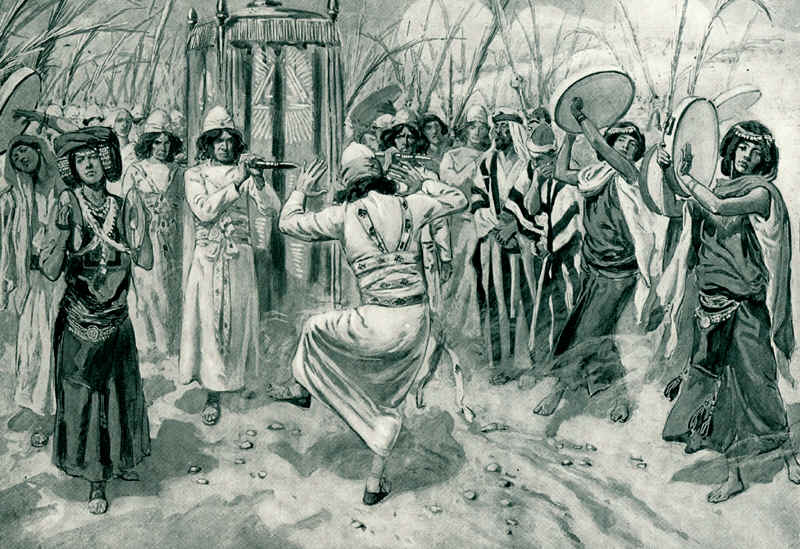
King David couldn’t have heard that musical phrase, but he certainly understood it. When they decided to bring the Ark of the Covenant to Jerusalem, he led the procession in a dance. “Gotta dance,” was the phrase of the day, because it wasn’t just David. It was other people in the procession. “David and all the house of Israel were dancing before the LORD with all their might, with songs and lyres and harps and tambourines and castanets and cymbals.”
The ark had been in one place for twenty years. Those were eventful years. Israel had selected a monarch for the first time, King Saul. That hadn’t gone so well. God had appointed a new monarch, David, and while the two worked together for a while David lived as leader of a small armed rebellion for many years. Saul and many of his sons died in battle with the Philistines, but one, Ishbaal, survived and was acclaimed king by the most of the twelve tribes. David ruled in the south until Ishbaal was assassinated, leaving David as undisputed monarch of Israel.
The next thing he did was to seize the Jebusite city of Jerusalem, which had been an independent city-state within the lands the Hebrew people inhabited. David made it the new national capital, and not-very-modestly named it “The City of David.” The new city would not be associated with either the house of Saul or with the places David had ruled while contesting for the throne. It was about as close as they could come to creating a new beginning.
About the only thing missing: the Ark of the Covenant. The chest which contained the stone tablets of the Ten Commandments. The symbol of God’s blessing. The central object that represented God’s commitment to the nation. It had been just ten miles away from Jerusalem for twenty years. The time had come to bring it to the political and social center of the nation, and make it the religious center, too.
As Richard W. Nysse writes at Working Preacher, “David’s exuberance can be read as pure gratitude for what Lord has granted him, but it can also be interpreted as politically astute manipulation.
“In other words, David’s motives are not pure and yet God is involved. Sin is real and faith is real; at times they are concurrent in one event and one character. The narrative leaves room for both readings. Perhaps it even insists on both readings, and thus depicts a world that has resonance with our own.”
Gotta dance. But who is he dancing for?
It’s easy to make David into a self-interested political manipulator. He did such things. The worst of them was the rape of Bathsheba and the murder of Uriah, but they’re not the only such acts. During his days as a rebel he was also a mercenary for neighboring (and hostile) nations as well as something of a bandit. As John C. Holbert writes in his blog at Patheos, “There can be little doubt that David loves YHWH in these wonderful stories. But there can also be little doubt that, at times at least, he loves himself more.”
Is that the case here? David paused the festival parade between verses 5 and 11 because of a tragic accident that killed one of the attendants. “David was angry because the LORD had burst forth with an outburst upon Uzzah…” says the text – not afraid, not cautious, not concerned: angry with God. That tends to reinforce some of my suspicious cynicism.
There are other reasons to work the politics of something, though, and that’s the welfare of the nation. David ruled a nation that had suffered years of low-level civil war while they were also vulnerable to repeated conflicts with their neighboring nations. Hostilities between David and surviving members of Saul’s extended family were still conceivable. It didn’t just serve David, it served the nation to create a new sense of unity, to demonstrate that the new monarch would rule justly and with care for everybody’s welfare. Jerusalem’s clean slate, if the Ark of the Covenant could be brought there, would be endorsed by the God of the Exodus who had brought everyone to a new home.
Look, everyone, it’s a new home.
Gotta dance for that.
Well. Maybe.
David’s first wife (the authors of Second Samuel had lost count of his wives in chapter five), Michal, “looked out of the window and saw King David leaping and dancing before the Lord, and she despised him in her heart.” If David had been channeling “Gotta Dance” she was in tune with the Jerome Kern song, “I Won’t Dance,” sung by Frank Sinatra in 1957 (and a whole lot of other people after that). Michal, it turns out, thought that David went over the top with his dancing, even making some pointedly rude comments about it. It basically ended any positive feeling in their relationship.
“Gotta dance?” Or “I won’t dance?” Which would you prefer?
Barbara Messner writes in her blog:
I have witnessed sacred dancing
that has stirred my very being:
wordless meaning that’s enhancing
prayer inspired by what I’m seeing –
spirit stirring, feelings freeing.Yet our mainstream church disdains it,
though the censure is unspoken:
formal liturgy restrains it
into gestures that are token,
careful that no power is woken.
The technicolor rainbow of Christianity has a lot of variety in it: in theology, in organization, in spiritual style, and in the energy of worship. There are parades in churches of the Roman Catholic, Orthodox, and Anglican traditions, but they don’t look much like David’s leaping and dancing. They’re grand; they’re stately. They’re measured; they’re dignified. And on any given Sunday morning, there’s church choirs swaying and even performing dance steps in Baptist churches. There are people crying out spontaneously from the congregation in Pentecostal churches.
On Palm Sunday here, we circle round the sanctuary singing and waving palms, and we might be dancing if I were better at it.
David and those with him, they chose, “Gotta dance.” Yes, there was calculation to it, but people do things for lots of reasons. As Amy G. Oden writes at Working Preacher, “David and ‘all the house of Israel’—all 30,000 of them!—dance before the Lord “with all their might” (verse 5)! Even the list of instruments: ‘lyres and harps and tambourines and castanets and cymbals’ (verse 5) conveys exuberance. Holy Presence may invite us into quiet contemplation, into bold action or renewed commitments. Here it evokes festive joy.”
We have some dancing enthusiasts among us. Not 30,000 of them. We have some singing enthusiasts among us. Not 30,000 of them, either. We aren’t terribly exuberant people here at Church of the Holy Cross. But… I know myself well enough to know that there’s some more celebration in me than I usually display. There’s some joyful energy even within this example of a New England Congregationalist, often known as “God’s Frozen Chosen.” I’m more likely to sing it than to dance it, but you know, it’s gotta come out.
Gotta sing. Gotta dance.
We’ve gotta sing and gotta dance because God’s blessings are manifest all around us. Look at those trees. Look at those flowers. Look at that sky (even if it’s gray). Look at that ocean. Look at those people whose smile is brighter than a sunrise. Isn’t that enough reason to rejoice?
But more: we have a congregation worth celebrating, one that care for our neighbors and welcomes the newcomer. We have a commitment to one another and to those who have gone before us. We live and serve with other congregations of the United Church of Christ and the universal Church who share our commitments, our ministry, and our joy. That’s worth celebrating, isn’t it?
And most of all: we have a God of love and grace, a God of forgiveness and redemption, a God of presence and inspiration. What we see and hear and smell and feel and taste is just a fraction of the wonder that is our God. God is with us.
God is with us. So yes: Gotta dance!
Amen.
by Eric Anderson
The image is David Danced before the LORD with All his Might (circa 1896–1902) by James Tissot – http://www.gci.org/files/images/jt/TissDanc.jpg, Public Domain, https://commons.wikimedia.org/w/index.php?curid=15343206.

I’m honoured to have my verses make an appearance in this intriguing if unpreached sermon. Thanks from Barb Messner
Thank you for the wisdom and insight!