Sermon: The Beginning of Wisdom

August 18, 2024

Psalm 34:9-14
Ephesians 5:15-20

I haven’t looked at my sermons over the last few years, but it seems to me that I tend to preach more somber sermons just before I got on vacation, and more cheerful sermons when I come back from them. Well, here I am, just back from vacation. So what am I thinking about?

Wisdom. You know. The fear of the LORD.

“The fear of the LORD is the beginning of wisdom.” We spoke that together during the Prayer of Invocation this morning, and the phrase “the fear of the LORD” showed up as well in Psalm 34.

What do you think? Should I have taken a longer vacation?

To reflect on wisdom, I’ve got the assistance of the letter to the Ephesians, which has such cheerful advice as to be wise, not foolish (and recognizes that foolishness is frequently more fun); not to get drunk with wine; and to make the most of the time, “because the days are evil.”

Perhaps the Apostle should have taken a vacation as well.

Frequently in the letters of the Apostle Paul, he provided us with a list of things to avoid. Curiously, though, there’s only one here: don’t drink to excess. That was good advice in the first century and it’s good advice today. I admit that it’s a bit simplistic. “Just say no” sounds good, but it fails to account for the power of addictive substances and behaviors over human beings.

But… where’s the rest of the list?

In fact, there’s only one other item on the list, and it’s not a “do not do,” it’s a “please do” item. What is wisdom? To be filled with the Spirit, and to sing psalms and hymns and spiritual songs, making melody to the Lord in your hearts, and giving thanks to God.

You know, that sounds almost… cheerful.

As novelist Paul Coelho wrote, “The simple things are also the most extraordinary things, and only the wise can see them.”

That verse from Psalm 111 is the one that sticks in our memory, isn’t it? “The fear of the LORD is the beginning of wisdom.” A lot of people aren’t fond of that verse, even if they do remember it. It’s not a cheerful verse. We don’t like fear. It feels bad. And in a church like ours, where our theology guides us to a more positive feeling about God, it feels wrong.

Which is something of a pity, because fear is such a handy emotion. It is, literally, life-saving. The fear response in the human body allows for quicker response to encounters with danger. Fear sometimes – not always – prevents people from entering dangerous situations. Fear sometimes – not always – prevents people from doing things because they fear the consequences. Honestly, it’s a pretty useful human characteristic.

Still, you don’t want to think about people around you as people to fear. You don’t want to fear people who love you.

Except that… I know I fear disappointing the people I love. I still do it, I’m afraid, but I fear it and that fear prevents me from disappointing them more often. And I fear disappointing God.

The fear of the LORD is the beginning of wisdom.

But it is not the fullness of wisdom. Because the Apostle, who I’m quite certain knew Psalm 111 backwards, forwards, upside down and sideways, utterly failed to go there when talking about what constitutes wisdom versus what constitutes foolishness. Even in a world which is evil, said the Apostle, wisdom is celebration. Wisdom is thanksgiving. Wisdom is singing.

As Sally A. Brown writes at Working Preacher, “Gratitude to the God who has become one of us—accompanying us even amid oppression, pain, isolation, and grief—is an act of holy defiance against all the forces, seen and unseen, that conspire to crush our faith and our hope.”

During my vacation I did a lot of traveling. I flew about 5,000 miles, then I drove to eight cities in four states. That’s a lot of driving for someone who rarely takes a trip longer than eighty miles. It’s also something I probably can’t sustain as the years advance.

Exhausting.

But.

I saw people I love and care about. I heard their voices. I heard their stories. We shared meals and laughter and hugs. And a few of the obligatory self-portraits.

Exhilarating.

So what is wisdom, and what is folly? To give my attention to the exhausting elements of my time away, or to give it to the exhilaration? Ephesians is clear: Wisdom is celebration. Wisdom is thanksgiving. Wisdom is singing.

I guess I’ll focus on the love and the stories and, of course, the obligatory self-portraits.

None of that means that the difficult things didn’t happen, or weren’t difficult. It doesn’t even mean that they were “worth it,” however anyone wants to think of that. The Apostle said the times were evil and it might have been one of the more obvious things to say about the world in which he lived. It’s a pretty obvious thing to say about the world in which we live.

But it is not the only thing to say about the world in which we live. We believe that God pronounced this Creation “good,” even “very good.” If we set our minds solely on the evils of this world then we commit the folly of appreciating the profound gift of God in Creation, in humanity, in our own lives. Some of ancient Israel’s neighbors had religions that believed the world to be a sort of cosmic accident at best, or the work of a malign deity at worst. In the first century, Gnosticism held that Creation imprisoned free spirits.

Judaism and Christianity following it rejected both ideas. The universe is a beautiful, sacred place, created by a loving God for the life and joy of those who live in it. We are not just accidents of fate. We are the image of God.

That’s a foundation of wisdom.

The Apostle knew as well that the news of Jesus’ death and resurrection was and is and will always be good news. Jesus did not come to condemn the world, but so that the world might be saved. When so many religions demanded sacrifice on the part of worshipers to their gods, Christianity celebrated the sacrifice of its God on behalf of human beings. The very word “gospel” is Greek for “good news.”

When someone gives you good news, what do you say? Me, I say, “Thank you.”

The Dutch theologian Meister Eckhart wrote, “If the only prayer you said was thank you, that would be enough.”

Mahalo nui loa, ke Akua.

Melissa Bane Sevier, writing in her blog, reflects on our culture’s demands for efficiency. “When the apostle writes that ‘the days are evil,’ I take that to mean that day upon day upon day can be evil if we don’t redeem the time. Sameness, boredom, work, heaviness, laboriousness. We redeem the time by filling it with things that give life to us and the people around us. Yes, sometimes that involves being efficient.

“But I’m also reminded that making the most of our time often means an efficiency of the spirit, which might be a far notion from checking off lists.

“How will you make the most of your time today?

“I’m planning to eat supper on the porch.”

Personally, I’m planning to enjoy our annual picnic, with its games and conversations, with its laughter and its life. I’m also planning to enjoy a few hymns and spiritual songs this morning. I hope you will, too, even those of you who aren’t enthusiastic singers. God ahead. Pray twice this morning.

The fear of the LORD is the beginning of wisdom, but not the only beginning. Joy in the LORD is also a beginning, and a constant companion for the journey. Look at what is around you, and not just to what is far away. Look at what is within you, and give thanks for the gifts you have received. Let your hearts, minds, and voices sing.

Amen.

by Eric Anderson

Watch the Recorded Sermon

Although Pastor Eric preaches from a prepared text, he sometimes improvises while preaching. Or he just makes an error. In either case, the recording will differ from the prepared sermon.

The image is the figure of Wisdom in the Basilique Notre-Dame de Fourvière, Fourvière, France. Photo by Vassil – Own work, Public Domain, https://commons.wikimedia.org/w/index.php?curid=7608542.
Sermon: Enough of This

July 28, 2024

2 Samuel 11:1-15
John 6:1-21

King David tends to dominate the Scriptures in which he appears. That’s true of the passages in which he’s mentioned, but it’s especially true when he took a major role in what the text describes. When David is in the room, there’s not a lot of oxygen for anybody else.

But.

This is Bathsheba’s story.

She bathed. The text is a little ambiguous, but strongly implies she was not just physically cleansing herself, but ritually cleansing herself. Her husband, a soldier in the army, was away at the siege of Rabbah. She was alone.

I don’t know whether any rumor came to her ears about people asking about her. What would she have thought if she did? Would she have worried about some unknown threat? Would she have trusted that her neighbors and friends would be able to protect her? Would she have simply thought, “I can’t believe anyone is asking about me.”

Did she simply not hear anything at all?

Then the messengers came from the King with a summons. What could that be about? Her husband was in the army – oh, no. Could this be the message every spouse of a soldier fears? Had her husband died? Been seriously wounded? Would she leave the palace in tears?

She arrived at the palace. There was the king. There were the other soldiers, the honor guard. Did they leave before he said, “Come to the bedroom”? Did they hear the king’s demand? Did the light glinting from their armor – and their weapons – add force to the orders of royalty? Or was it enough that swords and spears lurked in the hallway outside?

Gennifer Benjamin Brooks writes at Working Preacher, “Bathsheba is innocent of wrong-doing, even to the point of obeying the dictates of the king at the cost of her own peace of mind. As many in society she responds to the voice of authority because she is required to do so, because of the hierarchical structure of her world, which places her on the bottom.”

When the rape was over – and that’s what it was, do not mistake it – did she leave the palace in tears? Or did she hold her face as still as she might contrive, so that nobody would see her pain, her grief, her undeserved shame?

And then… she realized she was pregnant.

Why did she go to David, who had raped her? Her choices were limited. Gennifer Benjamin Brooks goes on to write, “It is the story of poor women everywhere who because of their poverty must turn for help to their abuser because she has nowhere else to turn.” Bathsheba would have stood accused of adultery on the evidence of her pregnancy. Israel’s law essentially required a woman to call for help during a sexual assault, assuming consent if she did not. It did not recognize that the threats of a king could enforce her silence.

So she told David.

What might she have expected? Perhaps she hoped for David’s honesty, that he would have spoken to Uriah, the soldier in his army. Perhaps she hoped that David would make some kind of offer to assuage her husband’s just wrath, that he might even take responsibility in a tangible way. I wonder if she even heard that Uriah was summoned back to the city. Did she know her husband maintained his fidelity to his army comrades? Did she know that David’s plan to cover up his crime had failed?

It’s always about the cover-up, isn’t it?

Joanna Harader writes at The Christian Century, “In this story, both Bathsheba and Uriah have what David lacks: integrity.

“It is easy to feel disappointed, even disoriented, when we find out that our would-be heroes aren’t so heroic after all. In our disorientation, perhaps we can reorient around those whose quiet courage and integrity challenge those who use their power in self-serving ways. Whenever there is a King David abusing people and power, we can usually also find Bathshebas—those who insist on speaking the truth about the abuse, regardless of the consequences. We can usually also find Uriahs, behaving with integrity even in the context of a corrupt system.”

I’m sure she didn’t know about the message David sent to his field commander, Joab, when Uriah returned to the army. You know. The order to murder.

Well, it worked. The next thing Bathsheba learned – in the sections of 2 Samuel beyond the passage we heard this morning – was that her husband had fallen in battle. She mourned.

Then David sent for her again, made Bathsheba his wife (one of his wives), and she bore his son.

Dear God.

“But the thing that David had done displeased the LORD.” (2 Samuel 11:27b)

Dear God, I hope it did. I hope it does.

The hashtag #MeToo gets less play on social networks than it did a few years ago. We’ve seen significant sexual assault convictions overturned on disputed procedural grounds. Significant public figures have been exposed as serial abusers, even rapists, to the shock and dismay of people who’d supported their politics or enjoyed their entertainment. “Honestly,” writes Joanna Harader, “the list of entertainers and church leaders who have turned out to be abusers is depressingly long. It’s almost as if power and prestige somehow facilitate abusive patterns and protect perpetrators!”

“Almost as if,” for sure.

As Robert Hoch writes at Working Preacher, “The Hebrew verb ‘to take’ in verse 4 (translated as ‘to get’ in the NRSV) recalls Samuel’s warning to Israel about the nature of kings: ‘These will be the ways of the king who will reign over you: he will take . . .’ (1 Samuel 8:11-18). ‘He will take your sons, your daughters, your fields, your wealth.’ Coercive power will be, according to Samuel, characteristic of the ‘ways’ of the king.

“It is also the way of rapists.”

Enough of this.

Jesus spoke those words to stem violence during his arrest in the Garden of Gethsemane, but I hear them echoing around sexual violence as well. There is no excuse. It’s not about clothing or the lack of it – remember that Jesus also advised that if your eye causes you to sin, pluck it out. It’s not about what any man “deserves” for physical intimacy. It’s what every woman (or man, or child) deserves for respect of their bodily, emotional, and spiritual well-being. Nobody is entitled to someone else.

Enough of this.

I’m tired of the excuses. In 2014 Jen Brockman and Dr. Mary Wyandt-Hiebert created the touring art exhibit “What Were You Wearing,” which combined clothing of assault survivors with their stories. Strikingly, as it moves from campus to campus, it accumulates new clothing and new stories which… breaks my heart.

Enough of this.

I’m tired of the discounting of women’s stories and of women’s value. Judges repeatedly decline to “ruin this young man’s life,” when he’s made a significant attempt at ruining a woman’s life. Rape survivors hold their silence, often for years, because they can’t bear the added insult to injury of not being believed by a system and a society which will, by that refusal to believe, betray them.

Enough of this.

I’m tired of the frequency of it all. According to the Rape, Abuse, and Incest National Network, an American is sexually assaulted every 68 seconds. One in six American women has been the victim of an attempted or completed rape in her lifetime. About 3% of American men – one in thirty-three – have experienced an attempted or completed rape in their lifetime. Using data from the National Sexual Assault Hotline, they find that 55% of assaults occur in the victim’s home.

Enough of this.

No more excuses. No more dismissals. And for the love of God, the only acceptable frequency for sexual assault is none.

David, this is not your story. It’s Bathsheba’s, a story of trust violated and power abused. Mercifully, it is not the end of Bathsheba’s story. As Wil Gafney writes at Working Preacher: “Bathsheba’s story ends in 1 Kings chapters 1-2. She and Nathan work together to get Solomon on the throne. In Bathsheba’s last appearance in the scriptures, Solomon installs her on a throne at his right-hand side, gets up off of his throne and bows down before her. This may well be the beginning of the tradition of the Gevirah, the Queen Mother as an authoritative office that would characterize the later Judean monarchy. This text is an important supplement to Bathsheba’s rape narrative in 2 Samuel 11 because she survives the rape and David and thrives in spite of what it and he has done to her.”

Thank you for your survival, Bathsheba, and for the survival of generations of women who have followed you. Someday, I hope and pray, there will be a last survivor, because the perpetrators will finally stop. May that day be today.

Amen.

by Eric Anderson

Watch the Recorded Sermon

Although I preach from a prepared manuscript (which is the same as the text above), I improvise from a preacher’s brain. What you read and what I preached may not be the same.

The image is Solomon and Bathsheba Enthroned, an engraving by Jacob Frey (der Ältere) (mentioned on object), after a painting by: Domenichino (1718-1719). Image by Rijksmuseum – http://hdl.handle.net/10934/RM0001.COLLECT.112815, CC0, https://commons.wikimedia.org/w/index.php?curid=83943779.

Sermon: Now That is a Shepherd

July 21, 2024

Jeremiah 23:1-6
Mark 6:30-34, 53-56

If you search Biblegateway.com for the word “shepherd” in the New Revised Standard Version of the Bible, you get 109 uses. I’m afraid that some of those appear in the occasional subheadings that modern-day editors have helpfully added, so the original numbers are somewhat lower. Still. 87 uses in the Old Testament, 22 in the New Testament. “Shepherd” is an important word.

One of the reasons for that was the cultural self-image of the Hebrew people. They saw themselves as shepherd people, those who followed the flocks of sheep and goats and therefore spent relatively little time in a fixed abode. Somewhat like the rivalry between the farmer and the cowhand in the Rogers and Hammerstein musical Oklahoma. Do you remember the song “The Farmer and the Cowhand Should Be Friends,” which basically feeds the bad feeling between them? Well, the shepherds were the ancient equivalent of cowhands, and the farmers and city dwellers of the eastern Mediterranean had a similar rivalry.

A fair number of those “shepherd” references in the Old Testament are variants on, “We’re shepherd people, and that’s the best thing to be.”

The Israelites also liked the image of “shepherd” for their national leaders. It might refer to priests or senior civic officials, but the favorite reference was to the king. David, of course, made the metaphor obvious, since as Psalm 78 says,

“He chose his servant David
    and took him from the sheepfolds;
from tending the nursing ewes he brought him
    to be the shepherd of his people Jacob,
    of Israel, his inheritance.
With upright heart he tended them
    and guided them with skillful hand.”

– Psalm 78

The one who really liked to compare kings to shepherds was Jeremiah. He used “shepherd” nineteen times, more than any other book of the Bible. And nearly always, he used it as we’ve heard it this morning. “Woe to the shepherds who destroy and scatter the sheep of my pasture! says the LORD.”

Jeremiah really didn’t have a high opinion of the kings of his day. Or a mediocre opinion. Low opinion is… getting close. He thought they were awful.

He did, however, provide us with an admirable summary of what a monarch, or a leader, should do and be: “he shall reign as king and deal wisely and shall execute justice and righteousness in the land.” As we come up to our primary election, with the likelihood that a number of our state and county races will be decided by this ballot, I humbly suggest that you vote for the candidates who display the attributes of wisdom and have the capacity and desire to execute justice and righteousness in the land. If they don’t… vote for somebody else.

Maren Tirabassi writes at her blog, GiftsInOpenHands:

I do know that every four years,
(with a tear-drop more anxiety this time around)
I want to believe verse four –

“I will raise up shepherds over them
who will shepherd them,
and they shall no longer fear or be dismayed,
nor shall any be missing, says God.”

even knowing that the Holy One,
is looking right at me
to be less of a hand-wringer,
and take responsibility for the raising-up.

But if you want a real shepherd, the place to look is the sixth chapter of Mark.

Earlier in the chapter, Jesus commissioned his disciples to widen his work, dispatching them about the villages and towns to teach and to heal. As they did so, word came to Jesus, and to the people of Galilee, that John the Baptist had been executed by King Herod. When the disciples returned, still excited about their success, Jesus took them off to go on retreat. They needed a break. They needed to tell their stories. They needed to do some grieving for John the Baptist, whose ministry still influenced them all.

Instead, they found a crowd had anticipated them and arrived before they did.

As Cheryl Lindsay writes at UCC.org, “Mark seems the least concerned with character development. We find out who Jesus and his disciples are by what they do and what they teach. Yet, even in this account, Jesus does a remarkable thing by prioritizing rest in the midst of impactful ministry and gathering crowds. This time, it is not his own rest, which he has already modeled as a spiritual practice. Jesus is as concerned with his disciples adopting a routine of rest within the rhythm of their coming and going.”

Jesus “had compassion for them, because they were like sheep without a shepherd, and he began to teach them many things.”

It has always impressed me that Jesus, despite his need and his disciples’ need of time to themselves, gave that up in order to serve the people who needed more. As we’ve been reading Mark’s Gospel this year, I’ve been struck by the number of times this happened to Jesus, that he tried to take time away and couldn’t. It’s a minor theme of the gospel, but it’s there. Jesus didn’t have a lot of luck taking time off.

I’m also struck by the appearance of that word, “shepherd.” As Matt Skinner writes at Working Preacher, “‘The system’ has failed the people who flock to Jesus, as evidenced in Herod Antipas’s lethal fecklessness (6:14–29).2 They are vulnerable in a predatory world. No one, it seems, guards their human dignity. They have to fend for themselves. What kind of society places people in that kind of condition?”

I hate to say it, but a lot of human societies do precisely that, and explain it away as… the way things are.

Jesus, however, seeing people in need of leadership, stepped in to provide it. That’s what you’d expect of a Messiah, come to think of it. A Messiah is a leader, a general, a king. “Let’s get together, people! Form up in ranks. To Herod’s palace, march!”

Only… he didn’t do that. At all.

He taught them. Remember what Jeremiah said a shepherd does? Deal wisely? Jesus is a shepherd who teaches wisdom.

I have to assume that some of the people on the beach came seeking healing, because that’s nearly always the case in Mark. Later in the chapter, when Jesus and his disciples, probably still looking for that private retreat, landed near Gennesaret, it was abundantly clear. They brought the sick out to the marketplace. They reached out to touch the fringe of his cloak, just like that woman with the hemorrhage. They were healed.

I say this a lot. People are impressed with power, with glamor, with fame. We tend to defer to people with those things whether their ideas are good, indifferent, bad, or downright horrid. Why, I wonder, don’t we value leadership like that displayed by Jesus? Why do we vote for the self-aggrandizing and power hungry, rather than the wise and the compassionate?

Jesus stepped onto the shore from the boat and saw the vacuum of power, the dearth of governmental concern, the absence of good shepherding. He saw a need. Then he filled it.

But he didn’t fill it with glitz. He didn’t fill it with glamor. He didn’t fill it with the coercive power which is a government’s most treasured privilege. He filled it with wisdom, with compassion, and with healing. Oh, and bread. That first beach they landed on, the one where Jesus saw them without a shepherd? At the end of the day Jesus fed all five thousand of them with five loaves and two fish.

Now that’s a shepherd. There’s one who really cares for the sheep.

Not all of us will take positions of leadership in society. There’s not room for everyone to be mayor, or governor, or president. There’s not even room for everyone to be pastor, or moderator, or a member of one of our governing boards of this church – though I will say that there is definitely room, and the nominating committee is hard at work to find those shepherds of our congregation for the next year.

Jesus didn’t commission his disciples to become mayors or governors or presidents or monarchs, or to be their supporters. He didn’t commission them to become generals or courtiers. He commissioned them to be apostles, teachers and healers. He commissioned them to be the same kind of shepherd that he was.

That is our summons, too. To follow Jesus as people who value and share wisdom, who do our level best to provide healing, who refrain from the acts that divide people and scatter them so that they are no longer cared for.

Because we are cared for by the one who is a true shepherd, guiding us in wisdom, justice, and righteousness, all the days of our lives. That’s a shepherd.

Amen.

by Eric Anderson

Watch the Recorded Sermon

Pastor Eric sometimes ventures away from his prepared text. He hopes he’s improving things.

The image is The Good Shepherd, a 4th century mosaic in the Basilica di Santa Maria Assunta in Aquileia, Italy. Public Domain, https://commons.wikimedia.org/w/index.php?curid=2239686.

Unpreached Sermon: Gotta Dance

This sermon was prepared for worship on July 14, 2024, but not preached because of the assassination attempt against a Presidential candidates on July 13. Instead, Pastor Eric preached “Repeating Myself.”

July 14, 2024

2 Samuel 6:1-5, 12-19
Psalm 24

In the 1952 musical film, Singing in the Rain, there’s a musical number that has never made any sense to me. I grant you that people suddenly bursting into song is standard fare for musicals, which doesn’t make sense to a lot of people, but I never had any problem with that. No, the movie introduces a musical number that’s being included in the fictional 18th century movie The Dancing Cavalier, and the musical number, “Broadway Melody,” is all about somebody who comes to Broadway to become a dancer.

And no, I never have been able to figure out how that went together, but hey, it’s a musical. It’s also amazing. Gene Kelly did some of his best dance work in the number, and it also featured Cyd Charisse. Most of all, it began and ended with Kelly’s musical shout, “Gotta dance!”

King David couldn’t have heard that musical phrase, but he certainly understood it. When they decided to bring the Ark of the Covenant to Jerusalem, he led the procession in a dance. “Gotta dance,” was the phrase of the day, because it wasn’t just David. It was other people in the procession. “David and all the house of Israel were dancing before the LORD with all their might, with songs and lyres and harps and tambourines and castanets and cymbals.”

The ark had been in one place for twenty years. Those were eventful years. Israel had selected a monarch for the first time, King Saul. That hadn’t gone so well. God had appointed a new monarch, David, and while the two worked together for a while David lived as leader of a small armed rebellion for many years. Saul and many of his sons died in battle with the Philistines, but one, Ishbaal, survived and was acclaimed king by the most of the twelve tribes. David ruled in the south until Ishbaal was assassinated, leaving David as undisputed monarch of Israel.

The next thing he did was to seize the Jebusite city of Jerusalem, which had been an independent city-state within the lands the Hebrew people inhabited. David made it the new national capital, and not-very-modestly named it “The City of David.” The new city would not be associated with either the house of Saul or with the places David had ruled while contesting for the throne. It was about as close as they could come to creating a new beginning.

About the only thing missing: the Ark of the Covenant. The chest which contained the stone tablets of the Ten Commandments. The symbol of God’s blessing. The central object that represented God’s commitment to the nation. It had been just ten miles away from Jerusalem for twenty years. The time had come to bring it to the political and social center of the nation, and make it the religious center, too.

As Richard W. Nysse writes at Working Preacher, “David’s exuberance can be read as pure gratitude for what Lord has granted him, but it can also be interpreted as politically astute manipulation.

“In other words, David’s motives are not pure and yet God is involved. Sin is real and faith is real; at times they are concurrent in one event and one character. The narrative leaves room for both readings. Perhaps it even insists on both readings, and thus depicts a world that has resonance with our own.”

Gotta dance. But who is he dancing for?

It’s easy to make David into a self-interested political manipulator. He did such things. The worst of them was the rape of Bathsheba and the murder of Uriah, but they’re not the only such acts. During his days as a rebel he was also a mercenary for neighboring (and hostile) nations as well as something of a bandit. As John C. Holbert writes in his blog at Patheos, “There can be little doubt that David loves YHWH in these wonderful stories. But there can also be little doubt that, at times at least, he loves himself more.”

Is that the case here? David paused the festival parade between verses 5 and 11 because of a tragic accident that killed one of the attendants. “David was angry because the LORD had burst forth with an outburst upon Uzzah…” says the text – not afraid, not cautious, not concerned: angry with God. That tends to reinforce some of my suspicious cynicism.

There are other reasons to work the politics of something, though, and that’s the welfare of the nation. David ruled a nation that had suffered years of low-level civil war while they were also vulnerable to repeated conflicts with their neighboring nations. Hostilities between David and surviving members of Saul’s extended family were still conceivable. It didn’t just serve David, it served the nation to create a new sense of unity, to demonstrate that the new monarch would rule justly and with care for everybody’s welfare. Jerusalem’s clean slate, if the Ark of the Covenant could be brought there, would be endorsed by the God of the Exodus who had brought everyone to a new home.

Look, everyone, it’s a new home.

Gotta dance for that.

Well. Maybe.

David’s first wife (the authors of Second Samuel had lost count of his wives in chapter five), Michal, “looked out of the window and saw King David leaping and dancing before the Lord, and she despised him in her heart.” If David had been channeling “Gotta Dance” she was in tune with the Jerome Kern song, “I Won’t Dance,” sung by Frank Sinatra in 1957 (and a whole lot of other people after that). Michal, it turns out, thought that David went over the top with his dancing, even making some pointedly rude comments about it. It basically ended any positive feeling in their relationship.

“Gotta dance?” Or “I won’t dance?” Which would you prefer?

Barbara Messner writes in her blog:

I have witnessed sacred dancing
that has stirred my very being:
wordless meaning that’s enhancing
prayer inspired by what I’m seeing –
spirit stirring, feelings freeing.

Yet our mainstream church disdains it,
though the censure is unspoken:
formal liturgy restrains it
into gestures that are token,
careful that no power is woken.

The technicolor rainbow of Christianity has a lot of variety in it: in theology, in organization, in spiritual style, and in the energy of worship. There are parades in churches of the Roman Catholic, Orthodox, and Anglican traditions, but they don’t look much like David’s leaping and dancing. They’re grand; they’re stately. They’re measured; they’re dignified. And on any given Sunday morning, there’s church choirs swaying and even performing dance steps in Baptist churches. There are people crying out spontaneously from the congregation in Pentecostal churches.

On Palm Sunday here, we circle round the sanctuary singing and waving palms, and we might be dancing if I were better at it.

David and those with him, they chose, “Gotta dance.” Yes, there was calculation to it, but people do things for lots of reasons. As Amy G. Oden writes at Working Preacher, “David and ‘all the house of Israel’—all 30,000 of them!—dance before the Lord “with all their might” (verse 5)! Even the list of instruments: ‘lyres and harps and tambourines and castanets and cymbals’ (verse 5) conveys exuberance.  Holy Presence may invite us into quiet contemplation, into bold action or renewed commitments. Here it evokes festive joy.”

We have some dancing enthusiasts among us. Not 30,000 of them. We have some singing enthusiasts among us. Not 30,000 of them, either. We aren’t terribly exuberant people here at Church of the Holy Cross. But… I know myself well enough to know that there’s some more celebration in me than I usually display. There’s some joyful energy even within this example of a New England Congregationalist, often known as “God’s Frozen Chosen.” I’m more likely to sing it than to dance it, but you know, it’s gotta come out.

Gotta sing. Gotta dance.

We’ve gotta sing and gotta dance because God’s blessings are manifest all around us. Look at those trees. Look at those flowers. Look at that sky (even if it’s gray). Look at that ocean. Look at those people whose smile is brighter than a sunrise. Isn’t that enough reason to rejoice?

But more: we have a congregation worth celebrating, one that care for our neighbors and welcomes the newcomer. We have a commitment to one another and to those who have gone before us. We live and serve with other congregations of the United Church of Christ and the universal Church who share our commitments, our ministry, and our joy. That’s worth celebrating, isn’t it?

And most of all: we have a God of love and grace, a God of forgiveness and redemption, a God of presence and inspiration. What we see and hear and smell and feel and taste is just a fraction of the wonder that is our God. God is with us.

God is with us. So yes: Gotta dance!

Amen.

by Eric Anderson

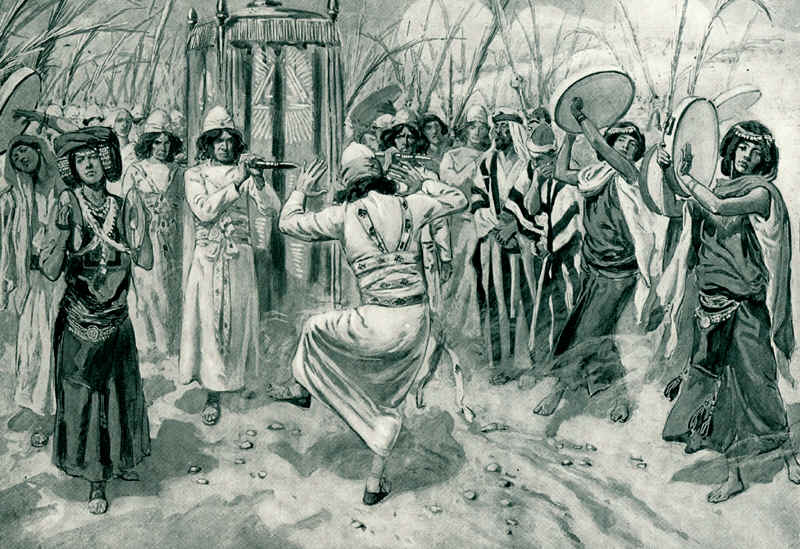
The image is David Danced before the LORD with All his Might (circa 1896–1902) by James Tissot – http://www.gci.org/files/images/jt/TissDanc.jpg, Public Domain, https://commons.wikimedia.org/w/index.php?curid=15343206.

Sermon: Repeating Myself

July 14, 2024

Exodus 20:13
Luke 22:47-51

From time to time on social media, I introduce a thought with something like these words: “I shouldn’t have to say this,” or “I shouldn’t have to say this again,” followed by, “but I guess it has to be said: You don’t get to kill people.”

Yesterday’s event in Pennsylvania, when someone with a rifle apparently attempted to assassinate Donald Trump, killed a spectator and wounded three people including the former president, leads me to say it again. You don’t get to kill people.

Honestly, that ought to be all I have to say about it, but sometimes a preacher has to toss out the prepared sermon about rejoicing in God’s grace and glory and take a look at the things we don’t rejoice in so much. Human violence.

I wrote this in 2016: “I guess it needs to be said: You don’t get to kill someone because they’re different. God made LGBTQ folks. Muslim folks. Black folks. Brown folks. You don’t get to kill them because of any of that.

“You don’t get to kill people because you’re angry, or scared, or offended, or embarrassed. You don’t get to kill them out of resentment or a sense of betrayal. You don’t get to kill them out of privilege or pride. You don’t get to kill them.

“When the sword flashed in the Garden of Gethsemane, Jesus said, ‘Enough of this.’

“Two thousand years and millions of dead later, haven’t we had enough?”

It took just three words in Hebrew for God to command us not to murder. Jesus used three words again to still his follower’s violence. I’m a lot wordier.

And it still isn’t enough.

Can we admit that we glorify violence? Can we admit that there is something compelling about the spectacle of it all? We don’t entertain ourselves with actual deaths, the way the Romans did, but we do entertain ourselves with imitated violence (the Romans did that, too). The ancient Hawaiians praised the prowess of their warriors, as did the Japanese, Europeans, and native Americans. That’s accomplishment in violence.

Amidst the acclaim of the warrior, where is the voice of Jesus saying, “Enough of this”?

The United States is awash in guns. We’re also second to Brazil in the number of deaths each year. I’ve said this before, too. The problem with guns is not the increase in violence, it’s the increase in deadly violence. Guns make it easier to kill.

With a lot of guns around, it’s shockingly easy to kill.

Can’t we make it harder?

I don’t know. Americans do like their guns.

To be honest, as long as continue to praise the warrior rather than the peacemaker, then the worship of guns rather than the worship of God will have dominion.

Enough of this.

I don’t really have a practical solution. I have a spiritual solution. It’s a spiritual solution that’s been available to humanity for the two thousand years since Jesus. It’s a spiritual solution that’s been available to humanity for the twelve hundred years or so before Jesus when God gave Moses the Ten Commandments. “Do not murder.” It’s got the virtue of simplicity.

For the most part, it’s worked.

It’s just not working well enough.

Please God, let it work better.

Amen.

by Eric Anderson

Watch the Recorded Sermon

Pastor Eric wrote this new sermon in response to the events of July 13, 2024, on the morning of July 14.

The image is La guérison de Malchus (The Healing of Malchus) by James Tissot (between 1886 and 1894) – Online Collection of Brooklyn Museum; Photo: Brooklyn Museum, 2008, 00.159.239_PS2.jpg, Public Domain, https://commons.wikimedia.org/w/index.php?curid=10904580.

Sermon: Weakness

July 7, 2024

2 Corinthians 12:2-10
Mark 6:1-13

“For someone says, ‘His letters are weighty and strong, but his bodily presence is weak and his speech contemptible.’”

When Paul wrote what we call the Second Letter to the Corinthians, he and the church in Corinth had been arguing both at a distance and in person. He had made what he described as “a painful visit” to the church, and had followed it with “a painful letter,” which doesn’t seem to have survived for us to read. Apparently that had led to the anonymous comment somebody passed along to him: “His letters are weighty and strong, but his bodily presence is weak and his speech contemptible.”

Isn’t it nice when people tell you things like that? Yeah. Not really.

Things were going better by the time Paul wrote this letter, however. Paul’s colleague Titus had visited Corinth and brought Paul a glowing report of improvements in the church there. At least one person whose actions or teachings had disturbed Paul had been disciplined somehow – I rather hope it was the one who made the “weak and contemptible” comment – and Paul promised to come back and spend some better time with people he loved.

Mind you, not all was forgotten. Paul still felt it necessary to remind the Corinthians of his qualifications as an apostle with that mix of hubris and humility visible throughout the apostle’s writings. As Celeste Kennel-Shank writes at The Christian Century, “This passage is classic Paul. He fully displays the qualities that make him admirable or annoying, or both at the same time.” He had spent a good portion of chapters ten and eleven boasting of his education, his call, his labors, and his sufferings as an apostle, salting the passage with his realization that the entire exercise of commending himself was foolish.

But was it foolish?

It’s campaign season in the United States of America – residents of other nations might be forgiven for wondering if it’s ever not campaign season in the United States of America – and commending oneself is what candidates do. “I’m the best.” “I’m the smartest.” “I have the best ideas.” “I’m right.” American political candidates would not write, as Paul did in the next verse following our passage today, “I have been a fool!” If a candidate has a physical ailment, they minimize or hide it. I leave it to you to come up with examples on our ballots. I’m struck by a subplot of the television series The West Wing, about a fictional President of the United States and his staff. Said President, Jed Bartlett, had been diagnosed with multiple sclerosis, and until forced by circumstances, hid the information from the public and from members of the administration.

I grant you that Hollywood isn’t life, but great heavens, haven’t we seen this over and over again among politicians and public officials?

In contrast, the Apostle Paul wrote that he suffered “a thorn in the flesh.” We don’t know for certain what he meant by this. He may have suffered an injury or an illness. He may have referred to a persistent opponent. One theory that has some wider support is that his vision was failing, perhaps originating with his loss of sight near Damascus. We can’t really know from what we have.

We don’t know what Paul suffered. What we do know is how Paul responded to it.

He took it as a caution not to become “too elated,” which reflects some profound self-understanding on Paul’s part. His letters reveal an ongoing struggle with ego, pride, and hubris, one which he sometimes lost. He used the “thorn in the flesh” as a psychic and emotional tool to help him contain that monumental ego. As Israel Kamudzandu writes at Working Preacher, “…in our prayer life and faith walk with God, there are some afflictions we have to live with and endure, for in them we will experience God’s grace. Deliverance is not just positive and instant, but God’s presence in our suffering is the answer we most need.”

That “thorn in the flesh” led Paul to prayer, and not just to speaking to God in prayer, but to listening to God in prayer. God said to Paul, “My grace is sufficient for you, for power is made perfect in weakness.”

Of all Christian assertions, from the creative power of God to the guidance of the Holy Spirit to the resurrection of Jesus Christ, this might be the most profound and the most challenging of all. “Power is made perfect in weakness.” Historically, Christians have struggled to live this one. We tend to favor embrace of power. We like the victory psalms of the Old Testament, and the victory stories like the Exodus, David vs. Goliath, the Resurrection. The Revelation to John makes a lot of people uncomfortable, at least up to the end where the forces of God are triumphant and the new heaven and the new earth emerge.

Our hymns resound with triumphant lyrics. “I Sing the Mighty Power of God.” “A Mighty Fortress Is Our God.” We grant remarkable titles to our leaders: “Reverend,” meaning “revered one;” “Bishop,” meaning “overseer;” and “Pope,” meaning “father.” When we imagine the coming of the reign of God, how many of us imagine something like a great army of angels marching down from heaven?

But it’s funny. That’s not what it looked like when somebody said, “the reign of God is at hand.”

What it looked like was someone whose power, while evident to others, could be discounted and dismissed by the people he’d grown up with. What it looked like was someone who, while entrusting healing power to his companions, directed them to rely entirely on the hospitality of others for their sustenance and shelter. What it looked like was someone who, though claiming a title of temporal power, Messiah, suffered the humiliating death of a common rebel.

That’s what it looks like to see power made perfect in weakness.

The Apostle Paul, for all that he knew what power made perfect in weakness was, and for all his self-awareness, well: I don’t think I can say that perfectly succeeded in making power perfect in weakness. I also think he knew it, and I think it annoyed him that he couldn’t do it.

I also think he knew that Jesus did do it, and that he rejoiced that Jesus did it, and that he urged us, one and all, to try to do what Jesus did, and I think he knew that we’d probably fail, too.

Let’s give it a try, though, to set aside this affection for power. Mahatma Gandhi is reported to have said, “The day the power of love overrules the love of power, the world will know peace.”

As we go through this campaign season, let’s decide not based on who will maximize the power of their office, but who will best resist the temptations of that power. As we make our choices for our day’s activities, let us choose the things that will lift others up rather than what only benefits ourselves.

And let us be honest about our limits, our ignorance, and our sufferings. In them we find those places through which God’s healing power can flow, perhaps to us, perhaps to others, perhaps to the entire world. We may think of them as weaknesses. God thinks of them as the openings for healing.

Amen.

by Eric Anderson

Watch the Recorded Sermon

We had some technical difficulties this Sunday, so there is a brief interruption in the recorded sermon, but it is brief rapidly resumes.

The image is Conversion on the Way to Damascus by Caravaggio – Self-scanned, Public Domain, https://commons.wikimedia.org/w/index.php?curid=15219516.

Sermon: Why Trouble the Teacher?

June 30, 2024

Lamentations 3:2233
Mark 5:21-43

I wonder how long they’d been waiting.

Jesus had been teaching along the shores of Galilee. It probably provided about as convenient an open area as they were likely to find near Capernaum. At the end of the day, you might recall, he had directed his disciples to sail across the sea (or lake, however you want to think of it). Personally, I think Jesus was looking for a day off.

It didn’t go all that well. They ran into a storm which forced his disciples to wake him up, and he was cranky about that. They pulled to shore in a place where people shouldn’t have known him. It wasn’t thickly settled with Jews. A perfect place to relax.

That’s when a possessed man found him and called him by name. Apparently the demons – they described themselves as “Legion” – recognized Jesus for who he was. Jesus, of course, could not leave these demons in possession of the man, so they asked to be sent into a nearby herd of pigs. He sent them there, at which the pigs promptly rushed into the sea and drowned.

That didn’t sit well with the locals, especially the owner of the pigs, I’m sure, so they told Jesus to go away.

So much for a vacation.

When Jesus and his friends returned to the Galilee side, they found a crowd, including Jairus, leader of a local synagogue and desperate to obtain Jesus’ aid for his ailing daughter. Had they been waiting all day and all night? I wonder. They headed for the house, with the crowd still milling about and probably getting in the way more than they cleared the way. As they went, a woman reached out and touched Jesus’ cloak, and suddenly twelve years of bleeding ceased.

As Cheryl Lindsay writes at UCC.org, “Their journey is interrupted by the hemorrhaging woman. It’s interesting to note that she did not intend to disrupt their movement. Unlike Jairus, she does not need an audience with Jesus to present her petition. She believes his touch will be enough.”

As it was. But it also interrupted the journey. Jesus did not want the recipients of his healing to be anonymous, at least not to him. He wanted to praise her daring to reach out to him in faith.

That’s when the messengers arrived with the tragic news that Jairus’ daughter had died.

It’s funny. I’ve read this story for decades and I have always blamed the woman for slowing everything down, for delaying Jesus before he could reach the girl. When the real delay was caused first by Jesus leaving the area in the boat, and second by the streets filled with people.

That’s when somebody uttered these crucial words: “Why trouble the teacher any further?”

I suppose it’s nice that somebody had some regard for Jesus’ time and welfare. Up to this point in the story, that’s been hard to find. Jesus’ reputation, thus far in the Gospel of Mark, had summoned crowds that make it difficult to eat, had prompted his family to wonder if he was crazy, had brought examiners out from the Jerusalem to see what he was up to, had forced him to cross the lake to get a break (and we know how that went), and had now got him stuck in a crowd so dense that his friends can’t imagine how he distinguished one touch from all the others.

Jesus had not been having easy days.

D. Mark Davis writes at LeftBehindAndLovingIt, “I do want to note that when Jesus turns and addresses the crowd, he takes back the agency of his actions. He was met immediately by Jairus and regardless of whatever his intentions were it seems that the urgency of Jairus’ daughter suddenly scripted Jesus’ actions. Then, the woman grabs his garment and his healing power goes out of him, with no reference to Jesus’ will or intent at all. Others are determining his actions and even his location. Until now. Now, he stops – as urgent as Jairus may be – he stops and turns and inquires.”

Up to this point in our text, Jesus had been pretty passive. He’d been swept along by Jairus’ plea, and then by the movement of the crowd, and had even healed the woman without making the choice to do so. We don’t often think of Jesus as swept along by the crowd, but in this story, that’s what happened to him.

Until he stopped it all. He took a breath. He asked who touched him. He learned who touched him. He praised the courage of her faith that made her well.

Then: “Why trouble the teacher any further?”

Now the teacher troubled himself. Having praised the woman for reaching out despite her fears, he continued the journey to Jairus’ daughter despite her parents’ fears. Reaching the house, he took charge. He cleared it of everyone except the parents and three of his disciples. Maybe they hadn’t said, “How can you say, ‘Who touched me?’ which Jesus clearly hadn’t appreciated. As D. Mark Davis writes, “Regarding the disciples’ effrontery, it is a wise guiding principle, when speaking to someone who is not stupid, to act as though what s/he has said is not stupid.” So yes. Jesus didn’t need those guys in the house.

And then: a woman who had suffered twelve years had reached out to him and been healed. Jesus reached out to a twelve-year-old girl and said, “Talitha cum. Little girl, get up.” And she did.

This time, Jesus didn’t say, “Your faith has made you well.” Nobody in the room said it, but perhaps one or two thought what I’ve been thinking: “Jesus, your faith has made her well.”

We value faith in the Christian Church. A declaration of faith is a basic part of membership in the Church. We ask it of people who are baptized as adults, and when people are baptized as infants, we ask it of them later at confirmation. When people join a new church, we ask them to affirm their faith again.

It’s almost like the price of admission. You want to see the Jesus movie? Let’s see your faith.

That gets more complicated when we look at our lives in relation to illness and healing. We hear Jesus’ words in the back of our minds, don’t we? “…if you have faith the size of a mustard seed, you will say to this mountain, ‘Move from here to there,’ and it will move, and nothing will be impossible for you.” “You of little faith, why did you doubt?” And: “Have you still no faith?”

But what if Jesus – what if God – has faith in us?

What if faith isn’t the price of admission, but an ohi’a seed that struggles in rocky crevices to somehow, beyond expectation, produce a shoot and branches and flowers? What if Jesus extends his faith in us to us, so that we can receive it and rejoice in it, so that we can nurture it and bear fruit in it? What if God cared so much about the world to make no distinction between those with wholehearted belief and those who wonder if they could have faith? What if God loved the world and its people whether they’re faith-filled or fearful? What if God so loves the world?

It’s clear that faith makes things possible that won’t happen otherwise. On the most basic, human level, a person who believes they can’t do a thing won’t do the thing, and the thing won’t happen. A person who has lost faith in the justice system won’t contest a lawsuit, and that probably means that justice won’t happen. A person who has lost faith in their body’s capacity to recover from an illness won’t seek medical attention, putting their healing at risk.

What faith doesn’t do is open up the compassion of God. God’s love and care flows to everyone, whether they are aware of it or not, whether they believe in it or not, whether they want it or not. Faith makes it easier – not easy, but easier – to accept that love and care and to flourish in it.

So why trouble the teacher? Because that is a way to seek what is already there, and in seeking to accept what is given. Troubling the teacher opens up our hearts, minds, souls, and bodies to the grace of God. Troubling the teacher opens the door so that power may come in and raise us up.

Troubling the teacher might even leave those words echoing in our souls: “Your faith has made you well.”

Amen.

by Eric Anderson

Watch the Recorded Sermon

Pastor Eric does make changes from his prepared text as he preaches. Just watch. He’ll do it.

The image is Christ Healing a Bleeding Woman, artwork found in the catacombs of Rome. Art by anonymous (2nd cent.) – http://campus.belmont.edu/honors/CatPix/womanblood.jpg, Public Domain, https://commons.wikimedia.org/w/index.php?curid=14728851.

Sermon: In Danger

June 23, 2024

1 Samuel 17:32-49
Mark 4:35-41

That little boat on the Sea of Galilee was in real danger. Galilee is shallow and surrounded by hills. That means that sometimes the wind gets channeled between the hills and kicks up the water into good-sized waves. It turns out that one of the worst times to embark upon the Sea of Galilee is night.

When Jesus and his disciples set sail.

Jesus, apparently, was worn out, because the heaving boat, the sound of waves and wind, and the cries of his friends didn’t wake him. This is somebody who could sleep on an airplane. The flying spray and the groaning boat eventually persuaded his disciples, some of them sailors, that something more than nautical skill was needed. In danger, in desperation, they called on Jesus.

And Jesus accused them of being cowards (that’s a translation offered by several commentators). Jesus accused them of not having any faith.

Huh?

Fear is the natural response of a human body in danger. Fear gets various glands busy, producing things like adrenalin that will give that extra kick of energy to fight or flee from danger. Fear is normal. It’s nothing to be ashamed of.

As for faith: they woke Jesus up for help, didn’t they? They went as far as human skill and strength could go, and then they followed their faith right to Jesus. He could help. He did help. See what faith can do?

Why didn’t Jesus see it that way?

I suppose it might be the way they asked for help.

“Teacher, do you not care that we are perishing?”

Yeah. That might be it.

How many of us, frustrated at something that didn’t happen that we wanted to happen, have asked a father or mother, an auntie or an uncle, “Don’t you love me? Then why didn’t you do this for me?” I’m pretty sure I remember doing that to my mother when I was four. It’s possible that I did it to my father when I was forty, but let’s not go into that.

It must be said that God has heard such things for centuries. Jeremiah called God a “deceitful brook, like waters that fail.” (Jeremiah 15:18) Psalm 10 asks, “Why, O LORD, do you stand far off? Why do you hide yourself in times of trouble?” Psalm 80 wonders, “How long will you be angry with your people’s prayers?” And of course, Psalm 22 opens with the words, “My God, my God, why have you forsaken me?” Jesus quoted that psalm from the cross.

The disciples knew what that felt like when they woke Jesus with those accusing words.

It turns out that wasn’t the faith Jesus had been hoping for.

It was one thing to believe that Jesus could make a difference in the storm. It was another to trust in his willingness to do so. Which would offend you more? That someone isn’t certain that you can do something, or whether you care enough about them to do it? These people were, at that time, the closest people in Jesus’ life. Of course he ached when they asked him, “Don’t you care?”

As for that fear, Debie Thomas writes at JourneyWithJesus.net, “The problem isn’t fear; the problem is where fear leads. When I face fearsome circumstances, my go-to position is not trust or even curiosity; it’s full-on suspicion. In my fear, I conjure up a God who is stony-faced, implacable, and loveless. A God to whom I am expendable. A God who withdraws. Once I’ve conjured that God, I withdraw, too. I curl up tight and focus on mere survival, convinced that I’m alone. All capacity for reflection disappears.”

The disciples were afraid. Nothing was going to change that. What did they do in their fear? Did they maintain their confidence that their friend and teacher loved them? Cared about them? Shared their lives and their trust? They could have done that, but that took courage, and they let courage fly away on the wind.

They got rebuked for it, but I’ll tell you, better a rebuke than drowning, in my opinion.

When Mark’s Gospel began to circulate among Christians, things were not good. The rebellion against Rome had erupted in Jerusalem, and the Temple had burned. Christians had been persecuted in the city of Rome under Nero and sporadically in other provinces of the Empire. Sharon H. Ringe writes at Working Preacher, “If Mark’s account of Jesus’ life and ministry were to be ‘good news’ for the church, it would have to proclaim that message in the midst of the storms through which they were living (and in which many were dying). It would have to shine a light of hope in the nighttime of the life of the church, and not only proclaim the coming ‘day’ of Christ’s longed-for return in power. This story affirms that still in that nighttime, when the long and perilous journey is in process, the cosmic authority of the crucified and risen Christ is with us. God is with us, and we are not alone.”

We are not alone. We are in danger, but we are not alone.

This is not the first century Roman Empire, and we are not subject to arrest and detention for being Christians in the US, no matter what some people claim. This is no longer 2020, and our risk from COVID-19 is much reduced from four years ago. Again, despite what some people claim, violent crime in the United States is down. Eric Levenson at CNN quotes FBI statistics for the first quarter of 2024: “The new numbers show violent crime from January to March dropped 15.2% compared to the same period in 2023, while murders fell 26.4% and reported rapes decreased by 25.7%. Aggravated assaults decreased during that period when compared to last year by 12.5%, according to the data, while robberies fell 17.8%.”

Rates in Hawai’i, by the way, tend to be significantly lower than the US as a whole.

So what are we in danger from? What’s the storm that’s threatening our boat?

Has anybody noticed that we’re getting older?

OK. You aren’t. But I certainly am. My portrait that hangs on the wall in the church Lounge alongside all the other pastors of this church shows somebody with a dark red mustache. It’s pretty much white now. When I worked for the Connecticut Conference, one of my tasks was to take photos at events. That meant I spent a lot of time crouching at the front of a room. Well, a few years ago I was visiting someone in a nursing home, and I crouched beside the bed because it was set low and there wasn’t a chair in the room. My legs went to sleep. When I finally got them awake enough to carry me out, I was sure that I was going to fall flat on my face in the hallway and the staff was going to admit me.

Sleepy legs aside, the simple truth is that aging is a pretty stormy thing, isn’t it? Not only do our bodies have more trouble doing the things we’re used to, they also start doing things we don’t want them to do. Hypertension. Heart disease. Decreased lung capacity. Neurological conditions. Cancer. How many of us have been in the boat accompanying someone through their storms? How many of us look ahead and see that the seas ahead may be rising, that the winds might be strengthening?

As I look ahead as a church leader, I see storm clouds. We in the United Church of Christ and in the mainline Protestant tradition have lost members, and influence, and resources over the years. Aging membership means storms for each of us, and it also means a storm for the church as a whole, as we confront the world’s deep needs with fewer people, and with less money, than we’ve had before. Well we might ask if Jesus cares whether the United Church of Christ, or Church of the Holy Cross UCC, exist.

Debie Thomas writes, “I think I will spend the rest of my life seeking this one grace — the grace to experience God’s presence in the storm. The grace to know that I am accompanied by the divine in the bleakest, most treacherous places. The grace to trust that Jesus cares even when I’m drowning. The grace to believe in both the existence and the power of Love even when Jesus ‘sleeps.’ Even when the miraculous calm doesn’t come.”

The one thing I am sure of is that when the storm is upon us, Jesus is there. God is there. The Holy Spirit is there. Sometimes over the years that has been a comfort. Sometimes over the years that has been a frustration. Sometimes over the years it’s been all that kept me going. Sometimes over the years it’s been the gentle arm over my shoulders when I had to come to a stop.

In danger, in the storm, go ahead and call for Jesus. Wake him if you feel you must. If you can help it, try to avoid, “Don’t you care?” It didn’t work with your mother, it’s not going to work much better with Jesus. But either way, Jesus will be there, the Holy Spirit will be there, God will be there, and in the midst of the storm, you will not be alone.

Amen.

by Eric Anderson

Watch the Recorded Sermon

Pastor Eric makes changes in the course of preaching. Mostly he hope these are improvements.

The image is Christ on the Sea of Galilee by Eugene Delacroix (1853) – https://www.philamuseum.org/collections/permanent/51982.html?mulR=258816936%7C28, CC BY-SA 4.0, https://commons.wikimedia.org/w/index.php?curid=77326827.

Sermon: Try Again, Samuel

June 16, 2024

1 Samuel 15:34-16:13
Mark 4:26-34

The first government of the Israelites after the Exodus was a pretty loose one. If there was a primary organizational concept, it was the tribe: Judah, Benjamin, Reuben, Gad, Dan, and so on. The primary leadership was the elder, or a council of elders. The nation as a whole didn’t really have a government, but someone would be acknowledged as a judge. The judge settled disputes, but also organized the nation’s resources in times of crisis, whether it be due to crop failures and famine or international conflict and war.

Samuel was the last of the judges. Judges weren’t just appointed; they came to the work through the call of God. The Scriptures suggest that there were periods when God simply didn’t summon up a judge. That may have contributed to the people’s feeling that this system wasn’t working. If you couldn’t be confident of a judge when you needed one, then you needed a monarch. One thing about kings: they’re always around.

God, by the way, didn’t think it was a great idea. God thought that a king would impose a lot of burdens on the people that a judge wouldn’t. As it happens, God was right. Most of the things God predicted came true under the first king, Saul, and continued to be true all through the period of the kingdoms. But as our text began this morning, Saul had exhausted God’s patience with a series of blunders. “And the LORD was sorry that he had made Saul king over Israel.”

Incidentally, that’s only the second time the Scriptures record that God was sorry about anything. The first time was when God was sorry about making human beings, and that led to the flood. As for the third time… there was no third time.

God was really unhappy about Saul. God decided to make a change.

Klaus Peter-Adam writes at Working Preacher, “… Yahweh’s ‘regret’ over Saul is best juxtaposed to God’s promise that as long as the earth endures (see Genesis 8:21-22), he would never again ‘regret’ as once before, when God erased all humans because they ‘grieved him to his heart’ (see Genesis 6:6-7). God’s regret specifically over Saul’s kingdom is thus embedded into God’s overarching whole-hearted affirmation to all of humankind.”

So God determined to try again. Or somewhat more accurately: Try again, Samuel.

Samuel had to try again seven more times. One son after another passed before the judge, and one son after another passed on. God assured Samuel that there were things in the heart that God could see, and that Samuel couldn’t, and that made the difference in who would be a suitable king. Eventually, Jesse ran out of sons, or so it appeared. “Are all your sons here?” Samuel asked.

Well, there was one left. You know who it was. It was David. “Rise and anoint him,” said God, “for this is the one.”

If this were a folktale, this would be a great ending. The youngest and least regarded had attained his realm and his true love (OK, that’s not in the story) and so he should live happily ever after. Those youngest sons – occasionally youngest daughters – so often become the heroes in folktales that, when I read one, I tend to predict who’s going to fail and who’s going to succeed, and I’m usually right. When the youngest one gets into the story, that’s the one.

But this wasn’t a folktale, though the writing may have been influenced by similar stories. Anointing David king wasn’t the end of the story, it was the beginning. David did not immediately wear the crown. Initially, he joined the household of King Saul and showed no signs of trying to replace him. The two ended up leading opposing armies in an armed rebellion where neither quite dared to enter a pitched battle. If they had, hostile neighboring nations might have taken advantage, and indeed they tried. This went on for years.

Even after Saul’s death in battle with a Philistine army, it took more years for David’s authority to be acknowledged by all the tribes of Israel. A lot of questions, a lot of decisions, a lot of choices had to be made before David reigned. They go back to: Try again, Samuel.

“If at first you don’t succeed: Try, try again.” You know that one, I’m sure. It’s somewhat countered by a more recent formula: “Insanity is doing the same thing over and over again and expecting different results,” written by Rita Mae Brown.

It’s not just barrel-rolling ‘apapane who do things like that. Businesses flounder when they continue to make the same products and fail to adapt to changing needs or tastes. Pullman made railroad cars for decades, nearly monopolizing the business, but didn’t move into new products as passenger traffic moved to aircraft. How many children have learned, to their shock, that the cute thing they did as a preschooler isn’t cute any longer in elementary school? How many governments have faced growing unrest for maintaining oppressive systems when the time to break them is long past?

If at first you don’t succeed, try something different.

There are parts of our lives that seem to contradict that piece of wisdom. Our experience is full of skills that take repetition to develop. Wood and metalworking. Knitting and crocheting. Quilting and embroidery. Singing and playing instruments. Athletics and driving. We repeat those things, we practice those things, we do those things over and over and we get better, so try, try again, right, Pastor?

Yes… and no.

When building skills like that, we’re not just learning what works. We’re learning what doesn’t work. What’s the proper position of fingers on the needles? That one? No. That one? No. That one? Well, that’s better.

If I’m preparing a vault as a gymnast, I’m going to get better as my muscles get more toned, but more than that, I’m going to get better because I adjust for things that slow me down or put me in the wrong place at the right time. As a musician, I know that the point of practice is, in part, changing the poor finger placement and finding a better one.

Practice, musicians say, makes permanent, not perfect. Good practice is when you change things until you find the techniques that will make permanent good.

Try again, Samuel. Try something different.

Indeed, that’s what he did. He stepped outside the expectations of the day that said a king would be succeeded by his son. He went to find someone else. Folktales might favor the youngest, but most cultures, including that of ancient Israel, favored the oldest son. Samuel tried something different when he anointed David. Anointing a new monarch or acclaiming a new leader (in contemporary terms) frequently kicks off an armed rebellion. Samuel tried something different there, too, so different that David served the king he was anointed to replace quite faithfully for several years.

Try again, Samuel. Try something different.

The last few years of pandemic have forced Church of the Holy Cross to a number of somethings different. Though most of our meetings take place face to face once again, and I’m profoundly glad that health conditions allow it, there are a few meetings that remain on Zoom because, it turns out, it’s pretty darned convenient to do that and they don’t demand the ongoing focused attention of an in-person meeting. We revised our communications so that we could remind people regularly that we are their church, that we care about you.

The most obvious, of course, is that we have cameras in our sanctuary each Sunday with a live stream and a recording on the Internet. We could stop. But we’ve found that we have more worshipers when we combine both here and home than if we did only one or the other. We’ve found that someone home with a brief illness can still worship, if not the way they’d prefer. We’ve found that someone with Sunday morning commitments can worship later in the week. We’ve found that someone with serious mobility limitations can still worship on Sunday or when works for them.

What adaptations are next? We made these quickly in response to the challenges of the day, and we’ve found that some of them continue to serve us. So to be honest, I’m taking a few deep breaths before looking at new things. It’s a gift to have time to consider things.

What I’m sure of is that God continues to guide us toward better options, better choices, better relationships. I’m sure that some things we try won’t work – if you check out the videos of our first few Sundays, you’ll find that we didn’t figure out how to make that work immediately. That’s OK. We learned, and we will learn.

Try again, Samuel.

Let’s make things better.

Amen.

by Eric Anderson

Watch the Recorded Sermon

Pastor Eric makes changes to the sermon as he preaches. Every time.

The image is Samuel Anointed by David on a silver plate made in Constantinople ca. 629-630. Photo by Fordmadoxfraud – Own work, CC BY-SA 3.0, https://commons.wikimedia.org/w/index.php?curid=4872820.

Sermon: Satan vs. Satan

June 9, 2024

Genesis 3:8-15
Mark 3:20-35

I think we would have to describe these events in the Gospel of Mark as a bad day for Jesus. That is, a day that would have been hard on him. He’d returned home from a teaching tour around Galilee, he’d appointed his inner circle of twelve disciples – and Mark helpfully reminded us that one of them betrayed him – and I’m pretty sure that he hoped to get a little bit of down time – Sabbath, now where have we heard that idea before? – in his own house. But no. The crowds assembled once again, and he and his friends couldn’t even get out of the building to find food to eat.

Not good.

Then Jesus’ family turned up. Why? They’d heard about his new activities. He’d clearly made a big shift from what he’d been doing, because they thought he was crazy. It’s something of an open secret that my grandmother didn’t want me to become a minister. She lived her life in a small town in the Berkshire Hills of Massachusetts, and the pastors of her small church were overburdened, poorly paid, and sometimes the targets of ill-defined anger. She didn’t want that for her grandson. Jesus’ family didn’t want it for their son, their brother. With the streets full of people, they couldn’t even get in to see him.

Not good.

And then we’ve got the Investigating Committee of scribes from the Temple in Jerusalem. Jesus must have developed a reputation pretty quickly to get Temple scholars interested in the goings-on of Galilee. They clearly arrived suspicious. I would guess they thought they’d find that the reports of healings and demon-banishings were exaggerated or erroneous. But no, they weren’t. So there must be another explanation. Satan vs. Satan, perhaps?

Not good.

David Schnasa Johnson writes at Working Preacher, “His family is up in arms and the authorities are raising questions about him. Jesus’ family is attempting to rein him in because they are worried about his eccentric ministry of healing, exorcism, and forgiveness in Galilee. Along come the authorities who wish to delegitimize Jesus with the damning diagnosis of Beelzebul-itus.”

Not good.

Do you recognize the impulse behind these two reactions, that of Jesus’ family and that of the scribes? It’s the one that drives conspiracy theories. Something has happened that you don’t like, and not only don’t like but don’t understand, or something so contrary to what you want that even if you do understand how it might have happened you can’t accept that explanation. So it’s got to be a conspiracy.

Jesus’ family adopted the most innocuous form: He was ill. He couldn’t make decisions properly. He wasn’t responsible for his actions. I can hear them telling themselves and others, “Calm down. Don’t wind him up. We’ll get him settled. We’ll take care of him. It will be all right.”

The scribes, however, went further down the conspiracy theory rabbit hole. Jesus was clearly doing extraordinary things. But they couldn’t accept that the source of his extraordinary power was God, because… well… “Give us a minute. There are reasons why a completely unauthorized self-appointed preacher with no training in the proper teachings shouldn’t go running around doing this. It’s got to be Satan.”

As is typical of conspiracy thinking, Jesus was able to demolish the flawed logic in a sentence. “If a house is divided against itself, that house will not be able to stand.” Satan vs. Satan makes a nice title for a sermon, but it’s a dreadful explanation for extraordinary things.

As Matt Skinner writes at Working Preacher, “Those scribes have dismissed the possibility of God’s restoration, for they write it off as a satanic deception. They show themselves devoid of hope and openly contemptuous of God’s work. Around them, people are being set free from their demons. People are experiencing wholeness and life. People’s dignity is acknowledged. Jesus promises that sins and ‘whatever blasphemies’ may occur will prove no obstacle to people’s renewal (Mark 3:28)! And yet the scribes scoff and denounce all of this as false or dangerous.”

Not good.

These bizarre accusations remind Dan Clendenin, writing at JourneyWithJesus.net, of an old saying by the 3rd century desert hermit St. Anthony the Great, who said, “A time is coming when men will go mad, and when they see someone who is not mad, they will attack him saying, ‘You are mad, you are not like us.'”

Not to contradict St. Anthony, but it had already happened. To Jesus.

Not good.

It would have been nice if Mark’s telling of this story had made the followers of Jesus more resistant to conspiracy stories and theories. I suppose it might have, but certainly not enough. Contemporary Christians have created abundant ways to delude themselves that are no more logical and no more open-minded than those suspicious scribes two millennia ago. My personal favorite is the accusation that Christians are oppressed in contemporary Western societies. Well, it takes a particular definition of oppression to conclude that. You have to believe that oppression is the same thing as not exerting complete control over everybody in a society, forcing them to do the things you want them to do or not to do the things you don’t want them to do. If I’m not given the power to make you do exactly what I say, then I am oppressed.

Um. No. Not even close.

Not good.

Now our text returns to Jesus’ family. This was a favorite writing technique of the gospel writer Mark, by the way. He loved to embed one story within another, so that one would comment on the other, and the two combined would strengthen the message.

They told him his mother and brothers were calling him. He said something deeply unsettling: “Who are my mother and my brothers?” I mean, ouch. I grant you that I’d be prickly if my family was outside telling people I was crazy, even though I also grant you that we should all consider that possibility. Still, “Who are my mother and my brothers?” They’re the ones who were worried about you, Jesus. They’re the ones who cared enough to brave the crowds to see you.

But that wasn’t Jesus’ final word. “Whoever does the will of God is my brother and sister and mother,” Jesus said. In a culture in which family was even more important than ‘ohana in Hawai’i – and that’s really important – Jesus extended his family. He opened it up and invited others in. He expanded it beyond what anyone might expect.

“Then here perhaps are we,” writes Meda Stamper at Working Preacher, “the crowd pressing in to see him and touch him, maybe urgently and desperately, but as the tale turns we find that our desperate desire has been more than met.  We also are claimed by him as his sisters and brothers and mother, no longer outsiders at a distance, but holders of the secrets of the kingdom, drawn into the inner circle of the mystery and love of God.”

I think I’d have to call this one: Good.

We have the option to adopt the conspiracy theory mindset if we like. We can believe that the world is exactly what we want it to be and when it isn’t, then there’s an organized evil force working against what we want. We can decide that leaps in logic are perfectly acceptable if it confirms what we want.

Not so good.

Or – and this isn’t precisely an either-or choice, but let’s go with it for now – we can accept that we don’t know everything, that God has more light and truth to spring forth into the world, that the possibilities of grace are beyond what we’ve considered. As Sara Wilhelm Garbers has written in her blog, “When we are caught up in the limitations of our human conceptions of kingdom, it means that we will perpetually struggle to remember that the whole reason that we say ‘Jesus is Lord,’ is because by doing so it means Caesar is not. And if we forget this and forget that the gospel invitation is into a family then we will keep on ordering our lives in response to earthly powers and imaginations and will give away our power to the kings of this earth who promise to fortify our egos and keep us from having to awaken to the seashore kin-dom family. For God’s kingdom is a kin-dom where we’re invited to take up the responsibility to love and lay down our lives.”

Like Jesus did. Which I’d have to call good.

Let the conspiracies, let the distrust, let Satan vs. Satan go. It was never worth it.

Jesus has invited you into the ‘ohana. That is worth everything.

Amen.

by Eric Anderson

Watch the Recorded Sermon

Pastor Eric makes changes while preaching. Often.

The image is Christ Teaching at Capernaum by Maurycy Gottlieb (1878) – Public Domain, Public Domain, https://commons.wikimedia.org/w/index.php?curid=76412193.